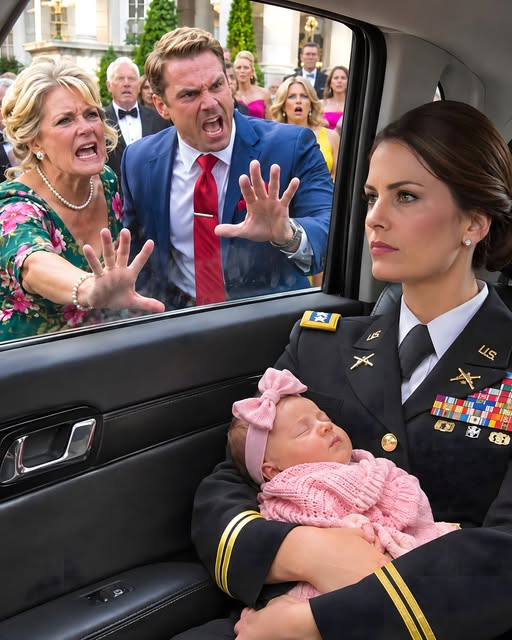
“She needs to learn her place in this family,” my mother-in-law said, holding up a dog coIIar at my five-week-old daughter’s welcome party. Sixty guests laughed. When she reached for my baby with the collar, I stepped back and looked at my husband. He was staring at the floor. So I took out my phone, recorded what his mother said next, and sent the unedited video to my father as soon as my daughter was safely in her car seat.
Part 1: My Mother-in-Law Gave My Newborn Daughter a Dog Collar at Her Welcome Party—But She Had No Idea I Was a Senior Army Officer
“She needs to learn her place in this family.”
My mother-in-law, Margaret Pembroke, held up a tiny black dog collar with a gold bell attached. Around sixty guests burst into laughter as she displayed it like an expensive piece of jewelry.
I stood beneath the crystal chandelier, holding my five-week-old daughter against my chest.
Margaret smiled at me.
“Since my son was generous enough to marry you, Nora, I thought your daughter should have a reminder of where she belongs.”
Another wave of laughter spread through the room.
My baby, June, was sleeping peacefully in her pink blanket, completely unaware that her own grandmother had just made her the center of a cruel joke.
I looked toward my husband.
Wesley Pembroke stood beside his father, staring at the floor.
He said nothing.
My name is Nora Ellis Pembroke. I’m thirty-four years old, and I serve as a senior officer in the United States Army.
But almost nobody in my husband’s wealthy family knew that.
The Pembrokes lived in Myers Park, one of Charlotte’s most expensive neighborhoods. Their family estate had marble floors, enormous gardens, and a driveway filled with luxury cars.
I came from a working-class family outside Dayton, Ohio.
To Margaret, that difference made me inferior.
What she didn’t know was that my father, Colonel Thomas Ellis, had served in the Army for more than thirty years.
He raised me to understand discipline, responsibility, and the importance of protecting people who depended on me.
I joined the military at eighteen, completed advanced command training, served overseas, and eventually took on senior leadership responsibilities.
Because my assignments required discretion, I rarely discussed my work at family gatherings.
Wesley knew about my career, but he never corrected his family’s assumption that I held an ordinary government office job.
Margaret had spent years making jokes about my background.
One Christmas, she gave me an apron embroidered with the words Know Your Rank while her daughters received expensive jewelry.
Wesley called it harmless humor.
I tried to ignore those insults because I loved my husband and wanted our marriage to work.
But this was different.
Margaret wasn’t humiliating me anymore.
She was humiliating my daughter.
“Put that away, Margaret,” I said.
She laughed.
“Oh, Nora. Don’t be so sensitive. It’s just a joke.”
Then she stepped forward and reached toward June with the collar.
I moved backward.
“Don’t touch her.”
June woke and began crying.
Margaret’s expression hardened.
“Give me the baby. You’re upsetting her.”
“No.”
The room went quiet.
Margaret looked toward Wesley.
“Are you going to let your wife speak to me like that?”
Wesley shifted uncomfortably.
“Mom, maybe you’ve made your point.”
“Your wife is being dramatic,” she snapped.
I looked at him, waiting for something more.
Nothing came.
So I took out my phone and began recording.
I captured Margaret holding the collar, the guests laughing, and her repeated comments about my daughter’s place in the family.
Then I collected June’s diaper bag.
“Where are you going?” Wesley asked.
“Home.”
“You can’t leave your own daughter’s party.”
I looked directly at him.
“Your mother tried to put a dog collar on our newborn baby, and you stood there watching.”
“It was a terrible joke, Nora.”
“No. It was a test to see how much humiliation I would accept.”
I walked out without raising my voice.
Once June was safely secured in her car seat, I sent the unedited recording to my father.
He called almost immediately.
“Are you and June safe?”
“Yes, Dad.”
“Send me everything. Don’t contact Margaret tonight.”
I recognized that tone.
My father wasn’t interested in starting a family argument. He wanted to understand exactly what had happened before deciding what needed to be done.
The following morning, Wesley arrived home looking exhausted.
“My father has called an emergency family meeting at the estate,” he said. “Everyone has to be there at noon.”
I continued folding June’s blanket.
“Then everyone can attend.”
Wesley hesitated.
“Nora, there’s something else.”
I looked up.
“Your father is coming too,” he said. “And he’s bringing an attorney and someone from his security team.”
For the first time since the party, Wesley seemed to understand that his mother’s behavior might have consequences beyond an uncomfortable family argument.
Part 2: My Mother-in-Law Humiliated My Newborn Daughter—Then My Father Confronted Her in Front of the Entire Family
At noon the following day, I returned to the Pembroke estate with June sleeping against my chest.
My father arrived in a black sedan, accompanied by Dana Mercer, a family attorney, and Captain Rafael Ortiz, a former military aide who now worked in security consulting.
Dad wore a simple navy suit.
He kissed June’s forehead before looking at me.
“Remember, Nora. We’re here to establish boundaries, not create a spectacle.”
Inside, the butler, Mr. Hale, approached us nervously.
“Mrs. Pembroke has requested that everyone surrender their phones before entering.”
My father shook his head.
“That won’t be necessary.”
We entered the sunroom, where nearly everyone from yesterday’s party had gathered.
Margaret sat beside the fireplace wearing pearls and a pale-blue dress. The velvet box containing the dog collar rested on the coffee table.
Her husband, Charles Pembroke, stood when we arrived.
“Colonel Ellis, thank you for coming. I’m sure we can resolve this misunderstanding.”
Dad looked at the box.
“Your wife tried to put a pet collar on my five-week-old granddaughter. What part of that was misunderstood?”
Margaret gave a dismissive laugh.
“Surely a military man understands that families sometimes make inappropriate jokes.”
“I understand the difference between a joke and repeated humiliation.”
He turned toward me.
“My daughter has tolerated years of disrespect. Yesterday, that behavior was directed at her infant.”
Margaret’s smile disappeared.
Dana opened her portfolio.
“Mrs. Pembroke, Nora has preserved the recording. She hasn’t published it or contacted the media. She’s here because your husband requested this meeting.”
“Are you threatening me with a lawsuit?” Margaret demanded.
“No. I’m explaining why everyone should take this seriously.”
I stepped forward.
“I’ve never asked your family to admire my background or my career. I’ve only asked to be treated respectfully.”
Margaret folded her arms.
“And now you’re using your father to intimidate us?”
Before I could answer, Wesley spoke.
“Mom, stop.”
Everyone turned toward him.
He looked directly at me.
“I should have defended Nora yesterday. I should have stopped those jokes years ago.”
Margaret stared at her son.
“Don’t apologize because your wife is making a scene.”
“I’m apologizing because I failed my wife and daughter.”
Charles finally stepped forward.
“Margaret, you owe Nora an apology.”
She refused.
Dana placed a document on the table outlining my boundaries.
Margaret would have no unsupervised contact with June until trust was rebuilt. There would be no degrading gifts, insults about my family, or interference with my parenting decisions.
Margaret scanned the page.
“You expect me to sign rules in my own home?”
“No,” I answered. “You can refuse. But you won’t have access to my daughter without respecting them.”
She turned desperately toward Wesley.
“Are you choosing her over your mother?”
“I’m choosing my wife and child,” he replied. “That shouldn’t be a difficult decision.”
After several uncomfortable minutes, Margaret signed.
Charles and Wesley added their signatures.
Then Wesley placed something beside the velvet box.
It was the apron Margaret had given me two Christmases earlier.
Know Your Rank.
“I found this in our closet,” he said. “I kept pretending these things were harmless because admitting otherwise meant confronting my mother.”
For the first time, Margaret looked embarrassed.
Charles opened the velvet box and handed the collar to Captain Ortiz.
“Get rid of it.”
Ortiz accepted it, but quietly secured it in an evidence bag instead.
As Dana gathered the signed document, Mr. Hale approached the table.
“Mr. Pembroke, there’s something you should know.”
Charles turned.
“What is it?”
“That collar arrived yesterday morning with a delivery. Mrs. Pembroke didn’t purchase it.”
Margaret went pale.
Mr. Hale continued.
“There was a typed note inside the package.”
“What note?” Wesley asked.
Margaret immediately interrupted.
“It was nothing. I threw it away.”
But Mr. Hale remembered part of the message.
“It said, ‘Start with the child, and she will remember who opened the door.’”
A terrible silence followed.
With Charles’s permission, Ortiz recovered the torn note from a wastebasket.
Dana carefully arranged the pieces.
Beneath the first sentence was another message.
Nora Ellis Pembroke was never meant to enter this family.
Ask Charles what he buried before Wesley was born.
I looked toward my father-in-law.
All the color had drained from his face.
“Charles,” Wesley whispered. “What does that mean?”
Charles gripped the mantel.
For several seconds, he couldn’t speak.
Then he looked at June.
“It wasn’t what I buried,” he finally said.
His voice broke.
“It was who.”
Part 3: My Father-in-Law Hid His Sister’s Existence for 40 Years—Then We Found the Letter She Left Behind
“Who did you bury, Dad?”
Wesley stared at his father, waiting for an explanation.
Charles Pembroke sat down heavily, his face drained of color. Across the room, Margaret gripped the arm of her chair.
“Please tell me this isn’t about Eleanor,” she whispered.
Wesley turned toward her.
“Who’s Eleanor?”
Charles lowered his head.
“My younger sister.”
I’d been married into the Pembroke family for three years, yet I’d never heard anyone mention her. Neither had Wesley.
“She was eighteen when everything happened,” Charles explained. “Our father wanted her to marry someone from a respectable family. Instead, she fell in love with Daniel Reyes, a young man who worked at our property outside Asheville.”
His parents considered Daniel beneath them.
When Eleanor announced that she wanted to leave Charlotte and study art in Savannah, they threatened to disinherit her.
Then Charles’s father began threatening Daniel’s livelihood.
“Eleanor was terrified,” Charles admitted. “I was twenty-two, and I knew what our father was doing. But I was afraid of him too.”
“Did she run away?” Wesley asked.
“I drove her to the bus station.”
Charles explained that Eleanor eventually married Daniel and settled near Savannah.
For almost a year, she sent letters describing their new life.
They had little money, but Eleanor wrote that she’d never felt happier.
“Then she asked me for help,” Charles continued.
He reached into his pocket and produced a small brass key.
“I kept this for forty years. It opens her old desk.”
Margaret stood abruptly.
“Charles, your father wanted those things destroyed.”
“My father has been dead for seventeen years,” he replied. “I’m done protecting his secrets.”
We followed him into the estate’s east wing.
Mr. Hale led us to a small bedroom overlooking a magnolia tree. Unlike the rest of the mansion, it contained simple furniture, colorful paintings, and shelves of old books.
Charles unlocked a cream-colored desk beneath the window.
Inside were several bundles of letters, a sketchbook, and an envelope addressed to him.
He opened the envelope, read the first few lines, and handed it to Wesley.
My husband began reading aloud.
Eleanor had written that Daniel had abandoned her after their marriage became difficult.
She was raising their six-month-old daughter alone.
The baby’s name was Lila.
Wesley stopped reading.
“You have a niece, Dad.”
Charles covered his face.
“I know.”
The letter explained that Eleanor needed money, identification documents, and somewhere safe to live. She wanted help without surrendering control of her daughter to the Pembroke family.
She asked Charles to meet her at an old train depot on May 14.
“What happened when you met her?” I asked.
Charles shook his head.
“I never went.”
His father had discovered Eleanor’s earlier letters and threatened to destroy Charles’s engagement to Margaret if he helped her again.
Charles had chosen his inheritance and marriage over his sister.
Three days later, Eleanor sent one final postcard.
It contained only four words.
I understand now, Charlie.
Charles began crying.
Then Mr. Hale revealed something even worse.
“Miss Eleanor came back that autumn,” he said quietly. “She brought her baby to the garden gate and asked to see you.”
Charles stared at him.
“You never told me.”
“Your father ordered me to send her away. He said she’d made her choice.”
The room fell silent.
For decades, Charles had believed Eleanor simply stopped contacting him.
Now he knew she’d returned, desperate enough to approach the very family that had rejected her.
Wesley looked toward June, sleeping against my chest.
“I almost let the same thing happen to my daughter,” he whispered.
Margaret’s eyes filled with tears.
“I knew Eleanor,” she admitted. “She once warned me not to let this family turn me into someone cruel.”
She looked at me.
“Yesterday, I became exactly the person she warned me about. I’m sorry, Nora.”
I acknowledged her apology, but I wasn’t ready to forgive her.
Meanwhile, Captain Ortiz had been examining Eleanor’s sketchbook.
He suddenly called Dana over.
Between two pages was a folded sheet of paper that looked much newer than the other documents.
Dana opened it.
“Nora,” she said, “this letter is addressed to you.”
My hands trembled as I read.
Eleanor’s daughter is alive, and she knows about June.
Then came the final sentence.
She was never the only child they tried to erase.
Before I could ask what it meant, the doorbell rang downstairs.
Mr. Hale glanced toward the hallway.
Charles looked frightened.
“No one else was invited.”
And when the bell rang again, Margaret whispered a name none of us expected to hear.
Part 4: My Mother-in-Law Tried to Humiliate My Baby—Then a Stranger Arrived With Proof of a 40-Year Family Secret
The doorbell rang a third time.
Margaret stood beside Eleanor’s old desk, staring toward the hallway.
“Lila,” she whispered.
Wesley turned to her.
“How do you know who’s at the door?”
“I don’t,” she answered quickly. “I was only thinking about Eleanor’s daughter.”
But her expression told me she was hiding something.
Mr. Hale went downstairs while my father asked everyone to remain in the room. I held June closer, still trying to understand the message addressed to me.
A few minutes later, Hale returned with a woman in her early forties.
She wore a simple navy dress and carried a worn leather folder. Her dark hair was pulled back, and her eyes looked remarkably like Charles’s.
“My name is Lila Reyes,” she said. “Eleanor Pembroke was my mother.”
Charles grabbed the back of a chair.
“You’re Eleanor’s daughter?”
Lila nodded.
“And you’re the uncle my mother spent most of her life trying to forget.”
Wesley stepped forward.
“Did you send the dog collar?”
“No. I sent the letter that came with it.”
I stared at her.
“You knew someone intended to humiliate my daughter?”
“I knew someone was planning to use your baby to send a message,” she replied. “I tried to warn you.”
She opened her folder and showed us copies of several emails.
Someone had contacted her three weeks earlier, claiming to represent the Pembroke family. The messages asked whether she would accept money in exchange for signing documents relinquishing any possible claims connected to Eleanor.
When she refused, the sender mentioned my marriage and June’s birth.
One message contained a disturbing sentence.
The newest Pembroke girl will learn the same lesson Eleanor learned.
My father examined the documents.
“Who sent these?”
“The account was registered under a company connected to this estate,” Lila answered.
Charles looked toward Margaret.
She shook her head.
“I’ve never seen those messages.”
Dana studied the paperwork.
“Then we’ll need to establish who had access to that account.”
Lila turned toward me.
“I came because I didn’t want another little girl punished for being born into this family.”
Her words struck me harder than I expected.
For the first time, I understood that the collar might have been more than Margaret’s cruel attempt at humor. Someone had deliberately delivered it with a message connected to Eleanor’s history.
Charles invited Lila to sit.
“Where is your mother?” he asked.
Lila’s expression changed.
“She died six years ago.”
He covered his mouth.
“She spent years believing you didn’t want to see her,” Lila continued. “She wrote to you several times after leaving Charlotte. None of her letters received an answer.”
Charles began crying.
“I didn’t know she kept trying.”
“That’s what she eventually told herself. That perhaps you never received them.”
Lila opened another envelope.
Inside was a photograph of Eleanor holding her daughter outside a modest house.
On the back, Eleanor had written:
We may not have their money, but nobody gets to decide what my daughter is worth.
Margaret lowered her head.
Then Lila removed a second document.
“This is why I came in person.”
It was a copy of an old family trust agreement.
According to Lila, Eleanor had been named as a beneficiary before she left home. Her father later claimed she’d voluntarily surrendered her interest.
“My mother never signed away anything,” Lila said.
Dana examined the signature.
“Are you saying this document was falsified?”
“I’m saying my mother kept the original correspondence, and the signatures don’t match.”
Charles looked stunned.
“My father told me Eleanor had accepted a settlement.”
“She never received one.”
The discovery changed the conversation immediately.
The humiliation at June’s party was no longer the only issue. Someone had been trying to keep Eleanor’s daughter away from the family while concealing questions about an old financial agreement.
Wesley looked at his father.
“Who manages that trust now?”
Charles hesitated.
Then he answered.
“Our family’s private investment office.”
“And who has been overseeing it for the last fifteen years?”
Charles looked toward Margaret.
She had gone completely still.
“My brother,” she whispered.
I remembered the anonymous warning.
She was never the only child they tried to erase.
Lila reached into her folder and placed one final photograph on the desk.
It showed Margaret’s brother standing outside a hospital beside a young woman holding a newborn.
On the back was a date from twenty-three years earlier.
And beneath it were three words that made Margaret begin to cry.
Part 5: My Mother-in-Law Humiliated My Newborn Daughter—But the Family Secret Finally Destroyed Her Power
Margaret stared at the photograph of her brother standing beside a young mother and a newborn baby.
“Where did you get this?” she asked Lila.
“My mother kept it with her letters. She believed your brother had another family he was hiding.”
Margaret sank into a chair.
Her brother, Robert, had managed the Pembroke family’s private investments for fifteen years. Charles trusted him with financial matters, including the old trust established by his father.
“Caroline is Robert’s daughter?” Wesley asked.
Margaret nodded reluctantly.
“He had a relationship before he married. The woman became pregnant, and he paid her to stay quiet.”
“Did your family know?” I asked.
“Charles’s father knew. He arranged everything.”
Lila opened another folder.
“My mother discovered the payments while trying to find out what happened to her inheritance. Robert contacted her afterward and threatened legal action if she continued asking questions.”
Charles looked devastated.
“So my sister was denied her inheritance, and Robert used our family’s money to silence another woman?”
“We need the financial records before drawing conclusions,” Dana cautioned.
My father agreed.
“Then preserve everything and let an independent investigation establish the facts.”
Over the following weeks, Charles hired outside attorneys and forensic accountants to examine the family’s trust accounts.
The investigation uncovered irregular transfers, questionable settlement documents, and payments connected to Robert’s former partner.
The original agreement supposedly signed by Eleanor was also examined. A handwriting specialist found significant discrepancies, and the records failed to establish that Eleanor had knowingly surrendered her interest.
Charles removed Robert from his position while the matter was investigated.
Robert denied wrongdoing, but eventually faced civil proceedings over the disputed assets and financial records.
Lila’s attorneys pursued the inheritance her mother had been denied.
Meanwhile, the source of the anonymous messages was traced to an account used by someone working under Robert’s direction.
The collar had been delivered to the estate as part of an attempt to intimidate me and draw attention to Eleanor’s history.
Margaret admitted she’d seen the threatening note before the party.
Rather than warn anyone, she’d decided to turn the collar into a humiliating joke.
“I thought I could make it seem ridiculous,” she told me.
“You could have thrown it away,” I replied. “Instead, you held it up in front of sixty people and laughed at my daughter.”
She couldn’t answer.
For the first time, I saw her understand that the anonymous sender hadn’t forced her to be cruel.
That had been her own decision.
Wesley and I began marriage counseling.
He acknowledged that he’d spent years excusing his mother’s behavior because confronting her seemed harder than disappointing me.
“I can’t undo what happened,” he told me one evening. “But I can stop expecting you to tolerate it.”
I wanted to believe him.
Still, I made it clear that apologies alone wouldn’t restore my trust.
Over the following months, Wesley respected my boundaries. He stopped pressuring me to attend family gatherings and supported my decision to limit Margaret’s contact with June.
Charles also began rebuilding his relationship with Lila.
He learned about Eleanor’s life after leaving Charlotte, the paintings she’d sold, and the daughter she’d raised without the family’s wealth.
Lila didn’t immediately forgive him.
But she agreed to meet him occasionally.
Eventually, the inheritance dispute was resolved through a financial settlement that acknowledged Eleanor’s disputed interest in the family trust.
Lila used part of the money to establish a small arts scholarship in her mother’s name.
One year after June’s welcome party, Charles invited us to a quiet family gathering.
There were no elaborate decorations or dozens of guests.
Just a few relatives sitting around a garden table.
Margaret approached me before dinner.
“I know I don’t deserve your forgiveness,” she said. “But I want you to know I’m ashamed of what I did.”
I looked toward June, who was playing beside Wesley.
“Then make sure she never has a reason to feel ashamed of how her grandmother treats people.”
Margaret nodded.
She didn’t ask to hold June.
That mattered more than another apology.
Later, Lila joined us carrying a framed watercolor painted by Eleanor.
It showed a little girl standing beneath a magnolia tree, looking toward an open gate.
Lila handed it to Charles.
“My mother painted this after she left Charlotte. She called it The Way Home.”
Charles held the painting carefully.
“I wish she’d known she could come back.”
Lila looked at him.
“She tried, Uncle Charles. What matters now is that nobody closes that gate on another child.”
I glanced at June.
She would grow up knowing her worth had nothing to do with her surname, her family’s money, or anyone else’s approval.
My father stood beside me as the evening ended.
“You handled this well, Nora,” he said.
“I was terrified sometimes.”
He smiled.
“Courage doesn’t mean you aren’t afraid. It means you protect what matters despite the fear.”
I watched Wesley lift June into his arms.
A year earlier, he’d remained silent while his mother humiliated our daughter.
Now he understood that protecting his family required more than keeping everyone comfortable.
Our marriage was still healing, and forgiveness would take time.
But June would never have to earn her place in our family.
The day Margaret held up that dog collar, she wanted to remind my daughter that she was beneath the Pembrokes. Instead, she exposed a family history built on silence—and gave us the reason to finally end it.