“A Sheriff’s Deputy Humiliated His Quiet Cousin in Public—Then Black SUVs Arrived and Changed Everything in an Instant”
For more than twenty years, my family believed I was the quiet one with the dull government job.
They believed that because I let them.
My name is Sarah, and in my family, being quiet was treated like a confession.
If you did not brag, they assumed you had nothing.
If you did not correct every insult, they assumed the insult was true.
If you did not post your accomplishments on Facebook with a filtered smile and a paragraph about blessings, they assumed life had passed you by.
So for more than twenty years, I carried grocery bags from driveways, helped rinse plates after holidays, stood at sinks with my sleeves pushed up, and listened while cousins and aunts and uncles talked around me like I was a chair that happened to breathe.
They called my job boring.
They called me a government pencil-pusher.
Once, at Easter, my aunt told me I had the personality of beige carpet and then asked me to pass the rolls.
I passed the rolls.
What none of them knew was that my actual work lived behind badge-controlled doors, sealed briefings, clearance files, and rooms where people stopped laughing before they said my name.
They did not know I was a major general in Army Intelligence.
They did not know because they were not supposed to know.
My life had been split into two clean halves for decades.
One half wore sensible shoes, brought paper plates to family cookouts, and let people assume she had peaked somewhere around age thirty.
The other half boarded flights at hours nobody should be awake, read reports that never touched public paper, and signed documents that could not be discussed at a dinner table.
That separation was not loneliness.
It was discipline.
And discipline had kept me alive longer than pride ever could.
The only person in my family who had ever touched the edge of that other life was my niece Chloe.
She was nineteen now, but I still remembered her at eleven, sitting on my kitchen counter in mismatched socks, eating cereal from a mug because all my bowls were in the dishwasher.
She had always been the one who noticed what people tried to hide.
If her mother cried in the laundry room, Chloe heard the washer lid close too hard.
If Brad came into a family party already looking for someone to belittle, Chloe took one step backward before anyone else understood why.
Years earlier, before an operation I could never explain to her, I gave Chloe a matte black card sealed in a thin plastic sleeve.
There was no logo on it.
No decoration.
Just one secure number and one instruction.
Never open this unless there is an absolute emergency.
She had laughed at first.
“Aunt Sarah, is this like a spy movie?” she asked.
“No,” I told her. “That is exactly why you need to take it seriously.”
I did not tell her my rank.
I did not tell her who would answer.
I did not tell her what would happen if she used it.
I only told her that if I ever gave her the signal, she should make the call and say exactly where we were.
That was the trust signal I gave her.
One card.
One number.
One person in that family I believed would listen when the room got dangerous.
On the Fourth of July, the whole family gathered at my sister’s house for the annual cookout.
The air smelled like charcoal smoke, sweet barbecue sauce, sunscreen, and grass baking under the afternoon sun.
Kids ran past the grill with sticky hands.
Ice cracked inside red plastic cups.
A small American flag snapped from the porch rail, bright and ordinary against the white siding.
My sister had paper napkins weighted down with a saltshaker, but the breeze still kept catching the corners and making them scrape across the picnic table.
It should have been a normal family afternoon.
It had all the usual pieces.
Too much potato salad.
One uncle pretending he knew exactly how long burgers needed on the grill.
Teenagers by the fence pretending not to listen while adults talked too loudly.
My aunt saying the lemonade was homemade even though I had watched her pour powder from a canister into a pitcher.
Brad arrived with his badge visible.
He always did that.
Brad was my cousin and a deputy sheriff in the county, and he had built his whole adult identity around making sure nobody forgot it.
He wore his duty belt to family events where no duty existed.
He clipped his radio high enough for people to hear it crackle.
He hooked mirrored sunglasses on his collar like a warning.
When he hugged relatives, the badge pressed against them first.
Brad had always needed witnesses.
Some people want love.
Some want money.
Brad wanted a room full of people to flinch when he raised his voice.
That afternoon, his excuse was my sedan.
I had parked at the edge of the driveway.
Not on the grass.
Not in front of the mailbox.
Not blocking anyone in.
The driveway was crowded with SUVs, pickups, folding chairs, coolers, and children running through places children should not run.
My car was exactly where it should have been.
But Brad did not need a real violation.
He needed an audience.
At 4:11 p.m., I saw him glance toward the driveway.
At 4:13 p.m., he made a joke about how some people thought government jobs made them special.
At 4:15 p.m., he told me I needed to move my car.
I looked past him at the open driveway space and said, “It’s not blocking anything.”
That should have been the end of it.
In normal families, maybe it would have been.
Brad smiled.
It was not a happy smile.
It was the kind of smile a man wears when he has been waiting all afternoon for permission to become himself.
“Don’t make this a thing, Sarah,” he said.
“I’m not making it a thing,” I told him. “You are.”
People near the grill started pretending not to listen.
That is one of the first sounds a family makes when it is about to fail you.
Not shouting.
Not protest.
Pretending.
Forks move slowly.
Conversations thin out.
Somebody laughs at nothing, hoping the moment will pass without requiring character.
Brad stepped closer.
His voice got louder.
“You government pencil-pushers think rules don’t apply to you.”
I looked at his duty belt, then at his face.
“Brad,” I said quietly, “this is a family cookout. Step back.”
He heard the quiet and mistook it for weakness.
That mistake had probably worked for him his whole life.
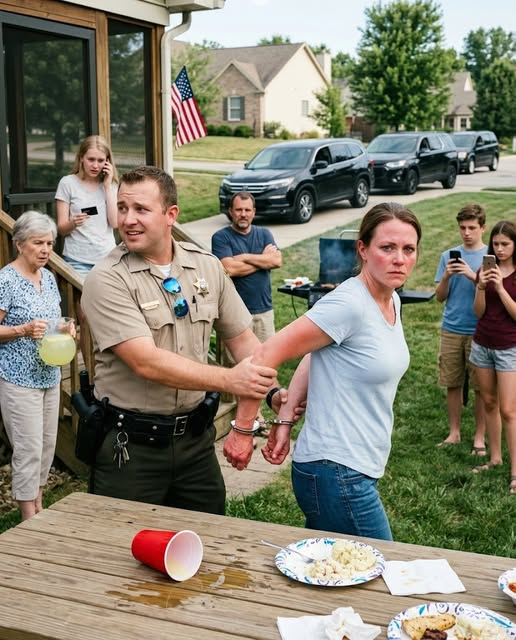
By 4:17 p.m., my cheek was pressed against the plastic picnic table.
The move happened fast, but not faster than I could understand it.
He grabbed my right arm.
He twisted it behind me.
He drove his knee into my lower back hard enough to make the table shudder beneath my face.
A red plastic cup tipped over inches from my mouth, and lemonade spread in a sticky line toward the table edge.
The smell of sugar and charcoal mixed with the hot plastic under my cheek.
“Stop resisting, Sarah!” Brad shouted.
I was not resisting.
That was the point.
He needed a sentence big enough to cover what he was doing.
He needed my silence to look like guilt and his violence to look like procedure.
“Brad, get off me,” I said.
My voice came out low.
Controlled.
Pain moved up my spine in a hot white line.
“You are crossing a line.”
He laughed.
Then I heard the cuffs.
There are sounds you do not forget.
Steel ratcheting shut is one of them.
The first cuff closed around my left wrist so tight the skin pinched.
The second bit into my right wrist before I had finished breathing through the pain.
My shoulder popped when he hauled my arm higher.
My teeth locked together.
For one second, the backyard blurred at the edges.
Then the world came back too sharply.
The grill smoke.
The lemonade.
The napkins scraping.
The small flag on the porch snapping in the breeze like nothing had changed.
“You’re hurting me,” I said.
Brad leaned close enough that I could smell mint gum and sweat.
“Maybe today you learn a little respect.”
He pulled me upright by the cuffs.
My wrists screamed.
My fingers started to go numb.
The metal had been cold at first.
Then it warmed against my skin.
Blood makes steel honest.
The backyard went still in the way only a guilty room can go still.
My aunt held a pitcher of lemonade halfway over a cup.
My uncle stared down at the potato salad as if looking directly at me might make him responsible.
A plastic fork slipped from someone’s hand and bounced once on the patio stone.
The teenagers by the fence had their phones half-raised, caught between fear, shame, and the strange modern instinct to record what you are not brave enough to stop.
One toddler stopped crying mid-breath.
The grill kept smoking.
Nobody moved.
I had been underestimated in rooms far more dangerous than that backyard.
I had sat across from men who smiled without blinking.
I had watched officers twice Brad’s size learn that volume was not leadership.
But family humiliation is its own kind of battlefield because everyone knows your childhood name.
Everyone knows where to put the knife.
Brad shoved me one step forward.
“Who’s the boss now, Sarah?” he said.
Somebody inhaled sharply.
Nobody told him to stop.
That was when I understood the full shape of it.
This was not confusion.
This was not a misunderstanding.
This was permission.
For decades, they had practiced disrespect in small ways, and now Brad had simply made it physical.
I stood straight.
I stood straight because if I bent, he would enjoy it.
I stood straight because if rage made the next decision, the story would become about my reaction instead of his abuse of power.
And for one ugly heartbeat, rage did offer me options.
I knew how to turn my shoulder and break his balance.
I knew how to hook my heel behind his ankle.
I knew how to put him in the grass before his hand ever touched his radio.
I used none of it.
Restraint does not look powerful to people who only understand force.
That is why they mistake it for weakness until the bill comes due.
Then I saw Chloe.
She stood near the back porch, half-hidden behind the screen door, pale under the bright July light.
Her lips were parted.
Her eyes were locked on my hands.
She had seen the cuffs.
She had seen Brad’s grip.
She had seen the family do what the family always did when cruelty came wrapped in confidence.
Nothing.
I met her eyes.
I gave her one sharp nod.
Her throat moved.
For half a second, she looked like the little girl on my kitchen counter again, holding a cereal mug with both hands and asking whether secrets were only scary when adults made them scary.
Then her hand slid into her pocket.
She stepped out of Brad’s line of sight.
And she made the call.
Brad jerked the cuffs again.
This time I could not keep the pain off my face.
“There it is,” he said, loud enough for everyone to hear. “Not so tough now.”
I looked at him.
He wanted begging.
He wanted tears.
He wanted the family to remember me bent over a picnic table while he stood above me with a badge and a grin.
“I’m not going to beg you, Brad,” I said.
His smile widened.
“But I strongly recommend you enjoy that feeling of power.”
The words landed strangely in the air.
A few people looked at me then.
Really looked.
Brad laughed because laughing was the only move he understood.
“What’s that supposed to mean?”
I looked past him to Chloe.
She was clutching the black card against her chest with both hands.
“It expires in about five minutes,” I said.
Brad laughed harder.
Then the street stopped sounding normal.
At first, it was only a low roll beneath the backyard noise.
Tires on asphalt.
Engines slowing together.
Brakes, sharp and synchronized, outside the house.
Brad turned his head.
So did everyone else.
The first black SUV appeared at the end of the street.
Then a second.
Then a third.
They moved with the clean confidence of people who already knew where they were going.
No sirens.
No flashing lights.
No confusion.
Just arrival.
The first SUV took the corner too fast for a family cookout and too cleanly for coincidence.
Brad’s grip changed.
For the first time all afternoon, he was not performing.
He was calculating.
The hand around my arm loosened by half an inch.
The cuffs shifted against my wrists, and I breathed through my teeth.
My sister stood on the porch with one hand pressed against the screen door.
Chloe looked like she might collapse on the steps.
The radio on Brad’s shoulder crackled once and then went silent.
A door opened before the first engine was fully quiet.
A man in a dark suit stepped out with a phone against his ear and a hard folder tucked under one arm.
Behind him, a woman in plain clothes scanned the yard with the kind of attention that counted witnesses, exits, weapons, lies, and fear in a single sweep.
Brad swallowed.
“Sarah,” he said.
My name sounded different now.
Smaller.
The man from the SUV ended his call and walked toward us.
His eyes went first to the cuffs.
Then to my wrists.
Then to Brad’s hand still gripping my arm.
The woman behind him looked at Chloe, then at the black card, then back at me.
She nodded once.
That was when Brad saw the folder.
It was not a county form.
It was not a parking citation.
It was not a piece of paper he could fold into his version of events.
It was an incident file.
His name was already on the cover.
My aunt dropped the lemonade pitcher.
It hit the patio stone and cracked in half, yellow liquid running around her sandals.
Brad looked at Chloe.
Chloe looked at me.
The man from the SUV stepped onto the grass.
“Deputy,” he said, calm enough to frighten everyone who understood calm, “remove your hand from the general.”
For a moment, Brad did not move.
Not because he was brave.
Because his mind was trying to reject the sentence.
General.
It moved through the backyard like a gust through dry leaves.
My uncle lifted his head from the potato salad.
One of the teenagers lowered her phone.
My sister whispered, “What?”
The man repeated himself.
“Now.”
Brad let go of my arm.
He did not uncuff me.
He simply released me, as if stepping away from the problem might separate him from what he had done.
The woman in plain clothes crossed the yard and stopped beside me.
“Ma’am,” she said quietly, “are you injured?”
“My wrists and shoulder,” I said.
Her eyes flicked to the cuffs.
“Do you consent to medical evaluation?”
“Yes.”
She turned to Brad.
“Key.”
Brad’s mouth opened.
No sound came out.
“Key,” she repeated.
He fumbled at his belt.
His hands were not steady now.
That was the first thing the family noticed.
Not my wrists.
Not the fact that I had been thrown against a table.
Brad’s hands.
Power had left them, and suddenly everyone could see how much of his confidence had been costume.
He unlocked the cuffs.
The steel came away from my skin with a small scrape that made Chloe cover her mouth.
Red marks circled both wrists.
One thin line had opened on the right.
The woman photographed them with her phone, not dramatically, not angrily, just methodically.
One wrist.
Then the other.
Then the table.
Then the tipped cup.
Then the spot where nearly fifty relatives had stood watching.
The man with the folder asked Brad for his full name, badge number, and supervising office.
Brad gave them.
His voice cracked on the badge number.
No one mocked him for it.
That is another thing families reveal.
They will watch a woman be hurt and call it complicated.
They will watch the man who hurt her get embarrassed and call it tragic.
My sister came down the porch steps slowly.
“Sarah,” she said. “What is going on?”
I looked at her.
For a long second, I saw every holiday where she had let them laugh.
Every phone call where she had asked why I could not just be easier.
Every time she had called Brad intense but basically harmless.
“He assaulted me in front of witnesses,” I said.
She flinched.
Brad tried to speak then.
“She was resisting.”
The woman in plain clothes looked at the teenagers by the fence.
“Who recorded?” she asked.
Three phones lowered at once.
Nobody wanted to be first.
Then Chloe stepped forward.
Her hands were shaking, but her voice held.
“I did,” she said.
Brad turned toward her so sharply that the woman stepped between them.
Chloe swallowed and held up her phone.
“I started recording when he grabbed her arm.”
That was the moment Brad understood the backyard had become evidence.
Not gossip.
Not family drama.
Evidence.
The man with the folder took a breath and looked at Brad like he was already several steps behind.
“Deputy, you are going to remain where you are while this is documented.”
Brad’s face reddened.
“You can’t order me around in my own county.”
The man glanced once at the folder.
“I would be very careful about the next sentence you choose.”
That quieted him.
Medical evaluation happened right there at first.
A responder from one of the vehicles checked my shoulder, my wrists, my pupils, and my grip strength.
He asked me to rate the pain.
He asked whether I felt numbness.
He asked whether I had hit my head when Brad forced me down.
Each answer went into a report.
Time.
Location.
Visible injury.
Witnesses present.
Process makes people nervous when they are used to controlling stories with volume.
Brad watched every note get taken.
The family watched too.
I think that was when they finally began to understand that truth is heavier when someone writes it down.
At 4:42 p.m., the woman in plain clothes asked Chloe to send the recording to a secure evidence address.
Chloe’s fingers shook so hard she mistyped twice.
I wanted to reach for her.
I could not lift my right arm without pain.
So I said, “You did exactly right.”
Her face crumpled.
“I was scared,” she whispered.
“I know.”
“I thought he was going to hurt you worse.”
“He might have.”
That sentence did something to the yard.
People looked down.
At their shoes.
At plates.
At the cracked lemonade pitcher.
Anywhere but at me.
Brad was not placed in a dramatic movie-style scene.
There was no shouting speech.
No patriotic music.
No grand reveal where I listed my résumé to people who had never earned the right to hear it.
There was only procedure.
His supervisor was contacted.
His weapon was secured.
His duty status was questioned.
Witness names were collected.
The incident file was updated before the potato salad had even gone warm.
When the man with the folder finally addressed me by rank in front of everyone, he did it quietly.
“General, transport is available when you are ready.”
My aunt made a sound like she had been punched.
My sister sat down on the porch step.
Brad stared at me with a face I had never seen on him before.
Not anger.
Not even fear.
Recognition.
He was seeing me for the first time, and the sight did not flatter him.
I should have felt satisfied.
Part of me did.
I am human enough to admit that.
But mostly I felt tired.
Tired of the years it had taken for them to believe I had weight.
Tired of knowing they only believed it when men in dark vehicles arrived to confirm it.
Tired of the fact that my pain had needed witnesses, documents, timestamps, and an official folder before my family could treat it as real.
Before I left, Chloe came down the steps.
She was still holding the black card.
“I didn’t know what would happen,” she said.
“You were not supposed to know,” I told her.
“Are you mad I used it?”
I looked at my wrists.
Then at Brad, standing very still while another person wrote down what he had done.
“No,” I said. “I gave it to you because I knew there might come a day when you were the only one brave enough to use it.”
She started crying then.
Not loudly.
Just silently, with one hand over her mouth, like she was trying not to take up space even in relief.
I pulled her close with my left arm.
It hurt.
I did it anyway.
My sister stood and took one step toward us.
“Sarah, I didn’t know,” she said.
That was the easiest sentence in the world for her to reach for.
I looked at her porch.
At the flag.
At the picnic table.
At the place where my face had been pressed into plastic while she stood ten feet away.
“Yes,” I said. “You did.”
She began to cry.
I did not comfort her.
There are moments when comforting someone becomes another way of letting them avoid what they owe.
Brad’s case did not end in the backyard, because real consequences rarely arrive all at once.
There were statements.
There was an internal review.
There were medical records from the evaluation of my shoulder and wrists.
There was Chloe’s video.
There were timestamps from the call tied to the card.
There were nearly fifty people who suddenly had to decide whether they wanted to keep lying for a man whose power no longer looked safe.
Some still tried.
My uncle said Brad had only been trying to calm things down.
My aunt said everyone was upset and maybe memories were confused.
One cousin claimed she had been inside when it happened, until Chloe’s recording showed her standing six feet away with a paper plate in her hand.
Documentation has a way of making cowards specific.
Brad was placed on administrative leave first.
Then the investigation widened.
I did not need to pull strings.
I did not ask anyone to ruin him.
He had brought his badge into a family backyard and used it like a toy weapon.
All I did was refuse to help him hide the marks it left.
Weeks later, Chloe came to my house.
She brought takeout because she said my fridge looked like it belonged to someone preparing for either a deployment or a power outage.
She was not wrong.
We sat at my kitchen table with paper containers between us.
The black card lay near her elbow.
She kept touching it, then pulling her hand away.
“You should take it back,” she said.
“No.”
“But it scares me now.”
“It should,” I said. “Responsibility usually does.”
She looked down.
“I keep thinking about how everyone just stood there.”
“So do I.”
“How do you forgive that?”
I took a long time before answering.
“Sometimes you don’t start with forgiveness,” I said. “Sometimes you start with distance, and you let the truth do whatever work people were too weak to do themselves.”
She nodded, but she was crying again.
This time, she did not hide it.
That mattered to me more than she knew.
The next Fourth of July, I did not go to my sister’s cookout.
There was one.
Of course there was.
Families like mine often try to keep the calendar moving so nobody has to name what happened on the last page.
My sister texted twice.
My aunt left a voicemail about healing.
One cousin sent a message saying Brad had suffered enough.
I deleted that one without answering.
Chloe came over instead.
We grilled burgers badly on my small back patio.
The buns got too toasted.
The lemonade was too sweet.
A paper napkin blew into the grass, and Chloe laughed so hard she nearly dropped her plate.
For a second, the sound brought me back to that table, that cup, that cuff around my wrist.
Then Chloe reached over and set the napkin under the saltshaker.
A small ordinary fix.
A hand doing what everyone else once refused to do.
Care is not always a speech.
Sometimes it is noticing what is about to blow away and holding it down.
For more than twenty years, my family thought I was a failure because I did not perform success loudly enough for them.
They thought quiet meant empty.
They thought restraint meant weakness.
They thought a badge made Brad powerful and my silence made me small.
They were wrong on every count.
That day in the backyard, almost fifty relatives watched him slam me into cuffs to show everyone who was in charge.
Then one young woman made one quiet call.
And by the time the black SUVs stopped at the curb, the whole family finally understood something I had never needed to say out loud.
I had never been powerless.
I had only been disciplined.