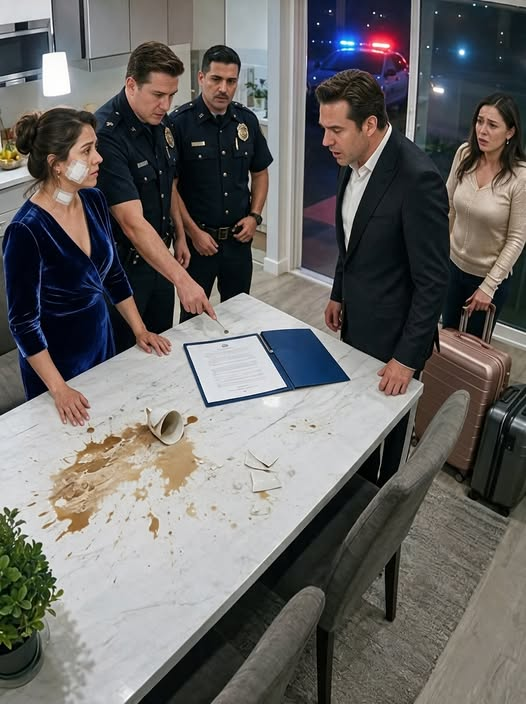
He Threw Scalding Coffee in My Face and Called It His House — He Never Checked Whose Name Was on the Deed
Part 2 — The Name on the Deed
He didn’t read it out loud. He didn’t need to. His mouth moved once, silently, over the single name printed at the top of the deed, and Brenda, still standing frozen with her suitcase against her ankle, leaned over his shoulder to see it for herself.
“That’s not possible,” she said. “You told me this was your place. You told me she just lived here.”
The officer looked between them, his expression carefully neutral in the way officers learn to maintain during exactly these moments. “Sir, can you confirm you don’t hold ownership interest in this property?”
Iván’s jaw worked silently for a moment before he found words. “My father-in-law bought this apartment as a wedding gift. I assumed it was in both our names.”
“It’s in my name alone,” I said, finally speaking. “My father gave it to me before we married, specifically in my name, because he never fully trusted you, Iván. I never corrected your assumption because it never seemed important enough to argue about, until today.”
“You let me believe—” he started.
“I let you believe whatever made you easiest to live with,” I said. “That was my mistake, not yours to weaponize.”
The second officer, who’d been quietly documenting the scene, turned to Brenda. “Ma’am, can I ask what you intended to do with those suitcases this evening?”
Brenda’s face flushed. “Iván told me to grab some things. He said Alejandra owed the family, that it was time to collect.”
“Collect,” I repeated. “You mean steal, while I was at the hospital getting burns documented from the coffee your brother threw at my face.”
“I didn’t know about the coffee,” Brenda said quickly, though her eyes wouldn’t meet mine.
“You knew enough to bring empty suitcases,” the officer said.
Iván’s confidence, the same unshakable certainty that had carried him through years of controlling our household, was visibly collapsing in real time, piece by piece, as he understood the full scope of what he’d walked into. “Alejandra, we can talk about this. Privately. This doesn’t need to involve the police.”
“It already involves the police,” I said. “It involved them the moment you decided burning my face was an acceptable way to negotiate.”
Part 3 — What the Neighbors Had Already Told Investigators
The officers separated Iván and Brenda into different rooms before continuing their questioning, standard procedure, one explained to me quietly, for situations involving potential coercion between family members present at a scene.
While they worked, I sat at the dining table with my folder of documents, the deed now returned to its place among years of careful, quiet preparation I hadn’t fully realized I’d been assembling until that exact evening — bank statements showing years of Iván’s controlling oversight of my spending, photographs I’d discreetly taken of bruises from earlier, smaller incidents I’d previously explained away as accidents even to myself, and a growing folder of Brenda’s “borrowed” items that had never once been returned.
Officer Delgado, who’d taken my initial statement at the hospital, returned to update me once his partner finished with Iván. “We’ve also reached out to a few of your neighbors, given the noise complaint history on file for this address. Two separate neighbors confirmed hearing raised voices and what sounded like physical altercations on multiple previous occasions.”
I felt something complicated settle in my chest, learning that neighbors had apparently documented, through complaints I’d never known about, a pattern I’d spent years minimizing even to myself.
“There’s also this,” Officer Delgado said, showing me his notes. “One neighbor specifically mentioned witnessing Brenda leaving your apartment carrying items in a shopping bag on several occasions when you weren’t home. She described it as looking ‘like she had a key and used it whenever she wanted.’”
“She does have a key,” I said slowly. “Iván gave her one years ago, without asking me.”
“That’s going to be relevant,” Officer Delgado said, “given what we found when we asked Brenda directly about tonight’s suitcases. She admitted, once separated from Iván, that this wasn’t the first time she’d come to take things while you were out. She described it as ‘helping herself to what the family was owed.’”
I closed my eyes for a moment, absorbing years of small, accumulated violations I’d apparently normalized simply by never confronting them directly — Brenda’s key, her casual thefts, Iván’s quiet insistence that everything in our shared space belonged, ultimately, to whoever in his family wanted it most.
“I’d like to press charges,” I said. “For the assault. And for whatever applies to what Brenda’s been doing with that key.”
Part 4 — The Restraining Order and the Locks
The following weeks moved with a clarity I hadn’t experienced in years, each decision arriving considerably easier once I stopped filtering my choices through the question of how Iván might react.
I filed for an emergency protective order the same week, supported by the hospital’s burn documentation, Officer Delgado’s report, and the neighbor statements confirming a pattern extending well beyond the coffee incident itself. The order granted me exclusive use of the apartment and prohibited Iván from contact or entry without my explicit consent.
I changed the locks the following morning, a process that felt considerably more significant than the simple mechanical act it actually was — the physical severing of Brenda’s unauthorized access, and by extension, the quiet years of assumed entitlement both she and Iván had built around what they believed they were owed simply by virtue of family connection.
Iván was formally charged with assault, given the documented burns and the medical report establishing clear injury from an intentional act rather than an accident. Brenda faced a separate charge related to unauthorized entry and theft, once the pattern of her previous visits, combined with my growing catalog of missing or “borrowed” items, established a case beyond what a single evening’s suitcases could explain away.
My father, once he learned the full scope of what had happened, arrived from three states away within two days, sitting with me through the more difficult parts of the legal process with a steady, quiet fury I hadn’t seen from him since my mother’s death years earlier.
“I never trusted him,” he told me, echoing what I already knew, though hearing it stated directly carried a different weight than the vague unease I’d absorbed from him over the years without ever fully understanding its source. “I put the apartment in your name specifically because something about him never sat right with me. I should have said something more directly, instead of simply protecting you quietly and hoping you’d figure it out on your own timeline.”
“I did figure it out,” I said. “Just considerably later than I should have.”
Part 5 — What I Rebuilt in the Same Rooms
Iván’s case moved through the court system over the following ten months, eventually resulting in a conviction on the assault charge, a sentence including probation, mandatory anger management courses, and the restraining order formally extended for an additional five years beyond the initial emergency period.
Brenda accepted a plea agreement on the theft charges, receiving a considerably lighter sentence given the relatively modest value of the items involved, though the conviction itself represented something I found unexpectedly significant — official, undeniable confirmation that what I’d spent years quietly absorbing as ordinary family dysfunction had, in fact, been theft all along, plain and legally recognized regardless of how casually she and Iván had always framed it.
I filed for divorce the same month I filed the assault charges, the proceedings moving relatively quickly given the clear documentation already established through the criminal case. I kept the apartment, obviously, given that it had never actually been anything Iván held legal claim to in the first place, despite years of behaving as though every square foot belonged to him by simple virtue of living there.
I redecorated slowly over the following year, not out of any dramatic gesture toward erasing the past, but simply because I found myself, for the first time in years, actually wanting things in my own space to reflect my own taste rather than accommodating someone else’s preferences and comfort.
My mother’s jewelry sits in a locked case now, one Brenda will never again have casual access to, each piece carrying considerably more meaning to me now than it did before I nearly lost the ability to protect any of it.
I still work in accounting, still balance other people’s books with the same careful attention I once brought to managing a household that never fully respected the effort I put into holding it together. I’ve started, slowly, dating again, though carefully, watching now for the small early signs I once talked myself past — the casual assumption of ownership over shared spaces, the sister or brother or parent who treats your belongings as family property, the quiet monitoring disguised as care.
I think about that Saturday morning often, the coffee cup hitting the table, the burn spreading across my face before I understood I was even being burned. I don’t think about it with the raw fear I initially carried in the weeks immediately after. I think about it now with something closer to clarity — the exact moment I finally stopped protecting a marriage that had never once protected me in return.
The deed still sits in that blue folder, back in its locked compartment, though I no longer need to hide it. Everyone who ever needed to know whose name belonged at the top of that document already learned the truth, standing in my kitchen, watching an officer’s finger slide beneath a single line of text that ended, definitively, every assumption Iván had ever made about what he believed was his.