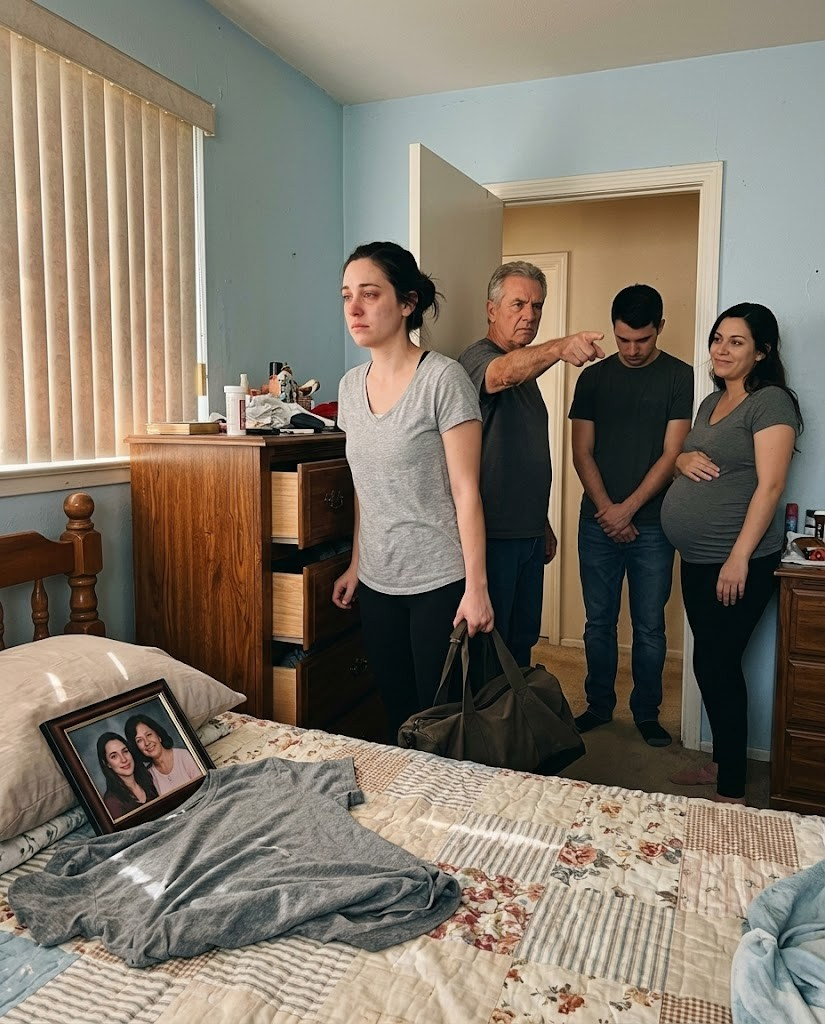
Two days after they threw Claire Hayes out of her own bedroom, Lauren called her shaking so hard Claire could hear the tremor through the phone.
“It’s not true,” Lauren whispered.
“I—please tell me you didn’t send it.”
But Claire already knew Lauren had opened the email.
She knew because the delivery receipts had appeared on her laptop in a cold little row: delivered to the attorney, delivered to the county recorder, delivered to the bank, delivered to Lauren.
The last one mattered more than Claire wanted to admit.
Lauren had been there when it happened.
She had stood in the doorway with one hand resting on her pregnant belly and the other curled around the strap of an expensive cream-colored tote bag.
She had looked at Claire’s books, Claire’s dresser, Claire’s mother’s photo, and Claire’s old quilt as if she were inspecting furniture left behind by a tenant who had overstayed her welcome.
Dad had stood in front of her, broad-shouldered, calm, and completely certain.
“Vacate the room, Claire.”
He didn’t shout.
He never had to.
Michael Hayes had spent his life speaking in a voice that made people obey before they realized they were obeying.
His anger was quiet, organized, and polished smooth from years of practice.
Claire had been sitting at her desk, sorting property tax reminders into a spreadsheet.
The house was warm enough to make the window glass sweat at the edges.
Downstairs, the refrigerator hummed, then clicked off.
For one strange second, she noticed everything: the lemon cleaner in the hallway, the dust across the blinds, the cheap black pen beside her laptop, the small stain on her nightstand from a mug of tea she had forgotten three nights earlier.
Behind her father stood Mark, her older brother, with his hand on Lauren’s shoulder.
He looked uncomfortable, but not guilty enough to speak.
“The baby needs space,” her father said.
“Mark and Lauren need privacy.”
Claire looked past him at Mark.
“And where am I supposed to go?”
Mark shifted his overnight bag from one hand to the other.
“Dad said you two would talk once things settled.”
Lauren’s eyes moved slowly around the room.
They landed on the framed photograph of Claire and her mother at the county fair, taken the summer before her mother died.
Then Lauren smiled.
“It would be better if you left the house altogether,” she said.
The words were soft, almost polite.
That made them worse.
Claire waited.
She waited for her brother to wince, to correct his wife, to say that was not what they meant.
She waited for her father to remember that Claire had lived there through doctor visits, hospice care, unpaid bills, furnace repairs, and every lonely winter after the funeral.
No one defended her.
So Claire stood.
“Okay,” she said.
Lauren’s smile flickered.
She had expected tears.
Maybe shouting.
Maybe proof that Claire was exactly what Dad had spent years calling her: dramatic, unstable, too emotional, too attached.
Claire gave them none of it.
She pulled a duffel from the closet and packed while they watched from the doorway.
She took work clothes, two sweaters, her passport, her Social Security card, bank records, and a USB drive hidden inside an empty mint tin.
When she reached for the framed photo of her mother,
Lauren cleared her throat.
“Maybe leave some things for now,” Lauren said.
“We have to set up the nursery before my doctor puts me on bed rest.”
“My mother’s picture?” Claire asked.
Lauren’s face tightened.
“Claire,” her father warned.
One word.
A leash.
Claire wrapped the frame in a T-shirt and placed it in the duffel.
Mark finally spoke.
“Don’t make this harder than it has to be.”
She looked at him then, really looked at him.
Her older brother had always been the golden one, the boy their father bragged about at church, the son who could fail upward and still receive applause.
He wore the watch Dad had given him after his first real job.
The watch cost more than Claire’s monthly car payment.
He would not meet her eyes.
Downstairs, Claire paused at the entry table.
A white envelope from the county office sat on the mail stack, her father’s name printed crookedly in the little window.
She had been waiting for that envelope.
Her hand hovered.
“Leave it,” Dad said from behind her.
Claire left it.
Outside, November air cut through her sweater.
Damp leaves clung to her windshield.
She loaded the duffel into her trunk, closed it gently, and looked once at the house.
No one came to the porch.
But as she backed out, she saw Lauren at the upstairs window, lifting one blind with two fingers.
Lauren’s other hand rested on her belly.
Claire drove until the house vanished behind the bare maple trees.
Then her phone buzzed.
The message came from an unknown number.
Don’t sign anything else for him.
Claire pulled under a streetlight.
Her breath caught.
She stared at the message, thumb trembling over the screen.
Before she could screenshot it, it disappeared.
She spent that night in a roadside motel beside the highway.
The carpet smelled faintly of bleach.
The curtains hung stiff and dusty.
Every truck that passed made the window rattle.
Claire placed her mother’s photo on the second pillow and sat cross-legged with her laptop balanced on her knees.
For six months, she had been collecting pieces.
The first piece had been a copy of her mother’s will tucked inside a recipe box behind a card for lemon pound cake.
Claire found it when she was looking for Thanksgiving recipes, trying to keep one family tradition alive.
The document was folded into quarters, yellowed at the edges.
One line had stopped her breathing.
One-half interest in the marital residence to my daughter, Claire Evelyn Hayes.
Not to Michael.
Not to Mark.
To Claire.
Her mother had created a trust three years before she died.
Claire remembered the day vaguely.
Her mother, pale under a blue scarf, had asked Claire to drive her into town.
They parked outside a small law office with green shutters.
Claire had been twenty-two, scared, and careful not to ask too many questions because her mother looked exhausted.
In the parking lot afterward, her mother squeezed her hand and said, “Someday, when they tell you you’re nothing, remember what I left you.”
At the time, Claire thought grief and medication had made her mother sound dramatic.
After the funeral, Dad told Claire the lawyer had made mistakes.
Then he said probate was complicated.
Then he said the house was not something women
in mourning needed to worry about.
Later, he said Claire was lucky to have a roof over her head.
Later became years.
During those years, Claire paid utility bills from her checking account when Dad was “between transfers.” She organized property tax dates.
She took county calls because Dad hated voicemail.
She signed documents he slid across the kitchen table.
“It’s maintenance paperwork,” he would say.
“Don’t be dramatic.”
The first time Claire saw her signature on a form she did not remember signing, she blamed exhaustion.
The second time, she scanned a copy.
The third time, she stopped trusting the kitchen table.
Now, in the motel, she opened the folder she had named “Taxes.” Inside were loan notices, scanned signatures, email chains, a tax delinquency warning, and a purchase amendment that made her skin go cold every time she read it.
Claire Evelyn Hayes voluntarily relinquishes occupancy and any remaining interest in the residence.
Below it was a signature that looked almost like hers.
Almost.
Beside another paragraph were Lauren’s initials.
Lauren had signed as “future household beneficiary,” confirming she understood the transfer would clear the way for Mark and Lauren to occupy and improve the home.
Claire read the line again and again.
Future household beneficiary.
Her bedroom.
Her mother’s picture.
Her life, reduced to a cleared space for someone else’s nursery.
Claire did not post anything online.
She did not call screaming.
She did not drive back and pound on the door.
She uploaded everything to the probate attorney whose card had been with the trust papers.
She sent the documents to the county recorder.
She sent copies to the bank’s fraud department.
And because Lauren’s initials were on the amendment, Claire forwarded the file to her too.
Then she waited.
Two days later, Lauren called.
At first, Claire heard only breathing.
Then Lauren whispered, “It’s not true.
I—please tell me you didn’t send it.”
Claire sat up in bed.
“Which part?”
A muffled shout sounded behind Lauren.
Mark’s voice.
Angry.
Frantic.
“Claire,” Lauren said, and for the first time since Claire had met her, there was no smug sweetness in her tone.
“He told me you signed.
He said you wanted out.
He said you were unstable and he was protecting the family.”
Claire closed her eyes.
Unstable.
That word had followed her since her mother died.
It appeared whenever she asked questions.
Whenever she remembered too clearly.
Whenever she refused to smile on command.
“I didn’t sign that page,” Claire said.
Lauren began to cry.
“Then why is my name on it too?”
Before Claire could answer, a new email appeared on her laptop.
Claire, call me immediately.
Your father has requested emergency transfer of the property this morning.
The attorney answered on the first ring.
“Do not return to that house alone,” he said after she gave her name.
“Your mother’s trust was never properly closed.
If these documents are authentic, someone has attempted to transfer property they did not fully own.”
Lauren texted Claire a photo while the attorney was still speaking.
It was taken through a car windshield.
Dad stood in the courthouse parking lot beside a man in a gray suit, holding a folder against his chest.
Mark’s hands were visible on the steering wheel.
Under the photo, Lauren had written:
He said if you show up, he’ll prove you’re mentally unfit.
A second message followed.
He has a doctor’s letter.
Claire’s stomach dropped.
She knew the doctor.
Dr.
Whitman.
Dad’s old friend from church.
The man who had prescribed sedatives to her mother after she begged neighbors not to leave her alone with Michael.
The same man who once told Claire that grief could make women “invent patterns.”
The attorney’s voice sharpened.
“Claire, listen to me.
Come to the courthouse.
Bring identification.
Bring the original flash drive if you have it.
I’ll meet you at the east entrance.”
Claire looked at her mother’s photo on the pillow.
For years, she had mistaken silence for survival.
That morning, survival looked different.
She drove to the courthouse with the USB drive in her coat pocket and her hands locked around the steering wheel.
Lauren kept texting.
He’s saying you disappeared.
He told them you forged emails.
Mark is panicking.
Then one message made Claire nearly miss a red light.
I found another folder in your dad’s trunk.
It has your name on it.
At the courthouse, the attorney, Daniel Price, was waiting by the east entrance.
He was older than Claire expected, silver-haired, wearing a navy overcoat and an expression that made people move aside.
“Your mother was my client,” he said.
“She was very clear about what she wanted.”
Hearing that nearly broke Claire more than being thrown out had.
They entered a small hearing room just as Dad was speaking to a clerk near the front.
Mark stood beside him, pale and sweaty.
Dr.
Whitman sat two rows back with a folded letter in his lap.
Dad turned and saw Claire.
For the first time in her life, she watched surprise crack his face.
Then he recovered.
“Claire,” he said, gentle enough for strangers.
“Thank God.
We were worried.”
She did not answer.
Daniel stepped forward.
“My client is here regarding the attempted transfer of trust property.”
Dad’s jaw tightened.
“Your client is confused.
She has been under emotional strain for years.”
Dr.
Whitman rose slightly.
“I’m prepared to provide a professional statement.”
“Are you?” Daniel asked.
“Because unless you have examined Ms.
Hayes recently under appropriate conditions, I’d advise caution.”
Mark looked at the door.
Lauren entered then.
She was breathless, one hand on her belly, the other clutching a manila folder.
Her face was blotchy from crying.
She did not look at Mark.
She walked straight to Claire.
“I’m sorry,” Lauren whispered.
Then she handed Daniel the folder.
Mark cursed under his breath.
Inside were copies of the forged relinquishment document, a draft petition claiming Claire was missing and mentally unstable, and an unsigned statement from Dr.
Whitman describing Claire as paranoid, erratic, and vulnerable to delusions.
There was also a printed email from Mark to Dad.
If she fights, we use the doctor.
Once the transfer clears, she has no leverage.
The room went very still.
Dad stared at Lauren with a look so cold Claire instinctively stepped closer to her.
“You had no right,” he said.
Lauren’s voice shook, but she did not back away.
“Neither did you.”
The clerk called a judge.
The emergency transfer was halted before noon.
The bank opened a fraud review that afternoon.
Dr.
Whitman left the courthouse without making his
statement.
Mark tried to claim he had only repeated what Dad told him, but the emails said otherwise.
Claire did not get the house back that day.
Legal things moved slowly.
Painfully slowly.
But the locks were changed under court order within a week, and Dad was barred from removing documents or property.
A forensic review confirmed that Claire’s signature had been copied from old maintenance forms.
The trust was validated.
Her mother had, exactly as Daniel said, been very clear.
Months later, the house was sold as part of a settlement.
Claire received her share.
Mark and Lauren separated before the baby was born.
Lauren sent one handwritten letter, apologizing for the doorway, the nursery, the picture, and the way she had enjoyed feeling chosen without asking who had been erased.
Claire read it twice.
Then she put it in a drawer.
Her father never apologized.
He called once from a blocked number and said, “Your mother would be ashamed of what you did to this family.”
Claire looked across her new apartment, at the county fair photo resting on a clean white shelf.
“No,” she said.
“She was the one who warned me.”
Then she hung up.
For a long time afterward, Claire wondered what hurt most: being thrown out, being lied about, or realizing how easily people had accepted her disappearance because it made room for their plans.
But sometimes, late at night, she remembered Lauren at the courthouse, shaking, ashamed, and still walking through the door with the folder in her hand.
It did not erase what Lauren had done.
It did not fix Mark.
It did not turn Dad into the father Claire had needed.
But it proved one thing Claire would never forget: the first person to benefit from a lie is not always the last person willing to tell the truth.