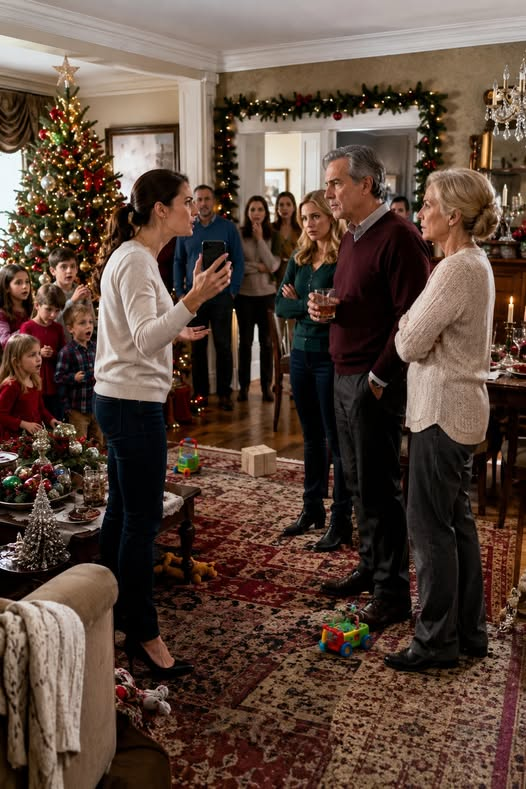
The first thing I heard when my mother opened the front door was a child laughing.
Not Christmas music.
Not glasses clinking beside the fireplace.
A child.
I stood frozen on the snow-dusted porch, holding six carefully wrapped presents, while a little boy wearing a gold paper crown raced through the hallway with a plate of sugar cookies.
Behind him, children shouted and giggled.
My fingers tightened around the gift bags.
“You told me children weren’t allowed.”
I kept my voice quiet, but somehow the entire hallway fell silent.
Mom’s smile vanished.
“Emily,” she whispered, glancing over her shoulder. “Lower your voice.”
I looked past her.
My sister Melissa’s three children were circling the Christmas tree. Two cousins had brought their kids. A teenager was helping the younger ones hang candy canes from the branches.
Toys covered the carpet. A holiday movie played on television. Small coats were piled across the staircase.
There were at least eleven children inside my parents’ house.
Only my seven-year-old son, Noah, had been told he could not come.
Dad appeared from the dining room holding a glass of bourbon.
“This is not the time for one of your emotional scenes.”
“You created the scene when you lied to me.”
His jaw tightened.
A week earlier, Dad had called while Noah and I were visiting a science store in downtown Seattle. Noah had stood beside a telescope, listening intently as an employee explained how mirrors gathered light from distant stars.
Dad told me the Christmas Eve gathering would be adults only.
I asked him twice.
“No children at all?”
“No exceptions,” he said.
He suggested Noah stay with my late husband’s parents, as though my son were a package I could simply deliver somewhere else.
It was our first Christmas without Ben.
Eight months earlier, my husband had died in an accident at the Northline Tower construction site.
Since then, Noah had suffered nightmares. Sometimes he carried Ben’s old work gloves around the house. Other times, he sat silently at the kitchen table, staring at his father’s empty chair.
Ben had loved Christmas with ridiculous enthusiasm.
He made cinnamon rolls before sunrise, wore sweaters covered in blinking lights, and let Noah choose one new ornament every year, no matter how ugly it was.
This year, I wanted Noah surrounded by relatives.
Instead, my father had deliberately excluded him.
I nearly stayed home. Eventually, I decided to drop off the gifts, stay briefly, and return to Noah before dessert.
Then I turned onto my parents’ street and saw booster seats through the windows of several parked cars.
My aunt approached and hugged me.
“Where’s Noah?”
From the dining room, Uncle David called, “Where’s our little scientist? I brought him something he’ll love.”
Everyone appeared genuinely confused.
No one else had been told the party was adults only.
Across the room, Melissa saw me and quickly looked away.
That was when I opened the camera on my phone.
Not because I wanted attention.
Because I needed evidence.
Throughout my childhood, my parents had rewritten events until I questioned my own memory. They denied exact words, changed timelines, and accused me of overreacting until I wondered whether I had imagined everything.
Tonight, I wanted a record.
Dad noticed the phone.
“We made exceptions for children who know how to behave properly.”
Mom adjusted her sweater cuff.
“Melissa’s children understand boundaries. Noah asks too many questions. He touches things. He constantly needs attention.”
Something inside me became completely still.
Not fragile.
Still.
“His teachers describe him as thoughtful and respectful,” I said. “He lost his father eight months ago. Did either of you consider what excluding him would do?”
Dad gestured toward the living room.
“Those children deserve to be included.”
I looked directly at him.
“And Noah doesn’t?”
“Don’t twist my words.”
Melissa entered the hallway with her arms folded.
“Noah is perfectly happy with Ben’s parents. You’re causing drama over nothing.”
“How long have you known your children were invited?”
“That’s none of your concern.”
At that exact moment, her youngest son threw a deviled egg at his brother.
It missed, struck a framed photograph, and dropped onto the carpet.
A child screamed. A glass overturned. Someone shouted about frosting on the couch.
I looked at Dad.
“These are the children whose behavior earned them an invitation?”
Mom responded immediately.
“Children behave like children.”
“But when Noah asks how a clock works, you call him disrespectful?”
Uncle David stepped into the hallway.
“Richard, did you actually tell Emily she couldn’t bring Noah?”
Dad lifted his chin.
“It was a private family decision.”
David laughed in disbelief.
“We are the family standing in your home.”
Conversations faded. Relatives moved closer.
My aunt covered her mouth when she understood what had happened.
Melissa leaned toward me.
“You’re humiliating everyone.”
“Humiliation and accountability aren’t the same thing.”
I walked into the center of the living room and explained everything.
I told them Dad had promised there would be no exceptions. I told them I had dressed Noah in the red sweater Ben bought before he died, then left him with his paternal grandparents.
I pointed toward the tree.
“Every other child was welcomed.”
One cousin shook her head.
“That’s disgusting.”
Dad raised his hand.
“That’s enough. You’ve made your point.”
“No,” I said. “I haven’t.”
I opened my banking application.
For four months, I had transferred one thousand dollars to my parents every month.
After Ben died, they claimed Mom had developed heart problems. They described specialists, medication costs, overdue taxes, and urgent home repairs.
Melissa claimed she contributed five hundred dollars monthly despite having three children and relying mostly on her husband Kyle’s salary.
Whenever I hesitated, they made me sound selfish.
So I paid.
The money came from savings Ben and I had built for a future he would never experience.
I held up the screen.
“You believe my money deserves a place in this family, but my son doesn’t.”
I opened the recurring transfer settings.
Dad stepped toward me.
“Emily, don’t make a decision you’ll regret.”
I pressed Cancel.
The application asked me to confirm.
I pressed it again.
Recurring transfer canceled.
Mom gripped the back of a chair.
Melissa stepped forward.
“You can’t do that.”
“I just did.”
“After everything we do for you—”
I laughed once.
“Everything you do for me?”
Kyle had been staring at my screen. Slowly, he turned toward Melissa.
“You’ve been sending them five hundred dollars every month?”
Melissa said nothing.
“You told me that money was going into the children’s college accounts.”
The color drained from her face.
I opened my transaction history.
“There’s something else you should see.”
Four payments had been transferred from my parents’ account to someone named Brandon Cole.
Each payment was made two days after mine arrived.
The notes were short:
Hotel.
Gifts.
Keep quiet.
Kyle’s eyes hardened.
“Who is Brandon Cole?”
Nobody answered.
Mom rushed forward.
“Emily, you had no right to show him.”
“My money made it my business.”
Dad slammed his glass onto the table.
“Enough!”
“You said Mom needed heart medication. Instead, my money paid someone to keep quiet. About what?”
Kyle grabbed Melissa’s phone from the side table.
She lunged for it.
“Give that back!”
He stepped away and searched Brandon’s name.
There were dozens of deleted messages in the recently deleted folder.
One read:
You promised Emily would never find out.
Another said:
I’m done lying about what happened at Northline.
My breath stopped.
Northline.
The site where Ben died.
Before anyone could speak, Kyle’s phone rang.
The caller’s name appeared on the screen.
Brandon Cole.
Kyle answered on speaker.
“Brandon?”
For several seconds, there was only static.
Then a man spoke.
“Melissa?”
“No. This is her husband.”
Silence.
Dad reached for the phone.
“Hang up.”
Uncle David blocked him.
Kyle’s voice sharpened.
“What happened at Northline?”
Brandon exhaled shakily.
“You need to ask Melissa.”
“I’m asking you.”
Another pause.
Then Brandon said the words that split my life into everything before and everything after.
“Ben’s death wasn’t an accident.”
My knees weakened.
The room blurred around me.
“What did you say?” I whispered.
“Emily?” Brandon asked.
“Yes.”
His breathing changed.
“I’m sorry. I should have come to you months ago.”
Dad moved toward the phone again.
“This man is unstable. End the call.”
Brandon continued.
“I was the crane supervisor at Northline. Ben discovered the load calculations had been altered. The steel shipment was heavier than the permits showed, but the project was already three months behind schedule.”
I remembered Ben coming home exhausted the week before his death.
He had barely touched dinner.
“There are things happening at work,” he had said. “I need to handle them carefully.”
I thought he meant office politics.
Brandon’s voice trembled through the speaker.
“Ben refused to authorize the lift. He said the wind was too strong and the support anchors hadn’t been inspected.”
I looked at Dad.
He had invested in the Northline development.
He had bragged about it for two years.
Melissa handled accounting for one of the project’s consulting firms.
“Who ordered the lift?” I asked.
Brandon hesitated.
“Richard did.”
The room erupted.
Dad shouted, “That is a lie!”
Brandon spoke louder.
“He said delays would cost investors six million dollars. Melissa had already forged Ben’s electronic approval.”
Kyle turned toward his wife.
“You forged his signature?”
Melissa’s lips moved, but no words emerged.
Brandon continued.
“Ben found out. He copied the original reports onto his field tablet and planned to deliver them to the city inspector.”
Uncle David slowly placed a wrapped package on the coffee table.
My eyes moved toward it.
“What is that?”
David’s face had gone pale.
“Ben’s field tablet.”
Dad spun toward him.
“You said it was destroyed.”
“I was told it was destroyed,” David replied. “A storage supervisor found it last week inside a locked equipment case. I had it repaired.”
He looked at me.
“I planned to give it to Noah because it contained photographs of him and Ben building model rockets.”
Suddenly, I understood.
My father had known David was bringing the tablet.
He knew Noah would ask questions about every photograph, every file, every unfamiliar symbol.
That was why Noah had been excluded.
Not because he misbehaved.
Because he noticed things.
Because he remembered details.
Because my son had inherited his father’s relentless curiosity.
Dad grabbed the package, but I reached it first.
“Emily,” Mom said, her voice unexpectedly calm, “put that down.”
Something about her tone made everyone stop.
For most of the evening, she had acted embarrassed and nervous.
Now her shoulders straightened.
Her eyes became cold.
“Mother?”
“You’re grieving,” she said. “You are allowing strangers to manipulate you.”
“Brandon isn’t a stranger.”
“No. He’s an alcoholic with gambling debts. That’s why he took our money.”
Brandon inhaled sharply.
“You told me the payments would protect my daughter.”
Mom’s face changed for half a second.
It was enough.
“What does he mean?” I asked.
Brandon spoke quickly.
“After the collapse, I tried to report everything. Margaret came to my house. She had photographs of my daughter outside her school.”
Everyone turned toward Mom.
She did not deny it.
Kyle stared at her.
“You threatened his child?”
Mom folded her hands.
“I protected this family.”
My stomach turned.
Dad looked at her.
“Margaret, stop talking.”
But she continued.
“Richard would have lost everything. Melissa would have gone to prison. The company would have collapsed. Hundreds of employees would have lost their jobs.”
“And Ben lost his life,” I whispered.
“It was not supposed to happen.”
The sentence was almost inaudible.
But my phone recorded it.
“What wasn’t supposed to happen?”
Mom closed her eyes.
“The lift was supposed to be delayed after Ben left the site.”
Brandon interrupted.
“No. Tell her the truth.”
Mom’s head snapped toward the phone.
“You should be careful.”
“I’ve been careful for eight months,” Brandon said. “I’m done.”
Then another voice came through the speaker.
“This is Detective Elena Ramirez with the Seattle Police Department.”
Mom’s face went white.
Brandon had not called alone.
He had been sitting inside an unmarked police vehicle two houses away.
For three weeks, he had been cooperating with investigators.
The payments made from my parents’ account were being tracked.
Detective Ramirez told us not to leave the house.
Mom grabbed her purse.
Uncle David stepped in front of the door.
“You’re staying.”
Sirens approached through the snow.
Red and blue light flashed across the walls.
Children began crying as their parents guided them upstairs.
Dad sank into a chair.
Melissa paced beside the tree.
Kyle stood completely still, as though the woman he had married had become a stranger before his eyes.
Two detectives entered with uniformed officers.
Detective Ramirez took the tablet, my phone, and Kyle’s screenshots.
Then she asked Mom to explain her statement.
Mom remained silent.
Dad did not.
He pointed at her.
“This was Margaret’s plan.”
Mom looked at him with absolute contempt.
“You ordered the lift.”
“You arranged the payments.”
“You begged me to protect you!”
Melissa burst into tears.
“I only changed the documents because Dad told me Ben had approved everything verbally!”
Kyle stared at her.
“Then why did you pay Brandon?”
“I didn’t know at first. Mom told me after the funeral.”
The detectives separated them.
Mom was led into the dining room. Dad remained beside the tree. Melissa sat near the fireplace, sobbing into her hands.
I thought the worst truth had already been revealed.
I was wrong.
Detective Ramirez returned carrying Ben’s repaired tablet.
“There’s a video on this device addressed to you.”
She handed it to me.
My hands shook as I pressed play.
Ben appeared on the screen wearing his yellow safety jacket. Wind roared behind him.
His face was tense.
“Emily, I hope you never see this. But if you do, something happened before I could reach the inspector.”
I covered my mouth.
“I found falsified reports connected to Northline. Richard approved them, and Melissa changed my digital authorization.”
He glanced behind him.
Then his voice lowered.
“But neither of them controls the project.”
The room became still.
“The controlling investor is Margaret.”
My mother.
Ben continued.
“She owns sixty-two percent of the development through three shell companies. Richard thinks he runs everything. He doesn’t. Margaret does.”
Dad looked toward the dining room in horror.
Apparently, even he had not known.
“Margaret ordered the project accelerated,” Ben said. “She threatened to ruin anyone who caused another delay.”
His eyes softened.
“Emily, protect Noah. Your mother heard him asking about my reports last Sunday. She knows he remembers things adults ignore.”
The video ended.
For a moment, nobody moved.
Then Noah’s voice echoed in my memory.
A week after the funeral, he had asked me an odd question.
“Why did Grandma tell Daddy not to be brave?”
I had assumed it came from a dream.
Now I understood.
Ben’s phone had automatically synced a voicemail to Noah’s tablet.
Mom must have realized Noah heard it.
That was why she never wanted him around.
That was why she called his questions disrespectful.
Detectives searched the house and found financial records hidden behind a false panel in my parents’ study. The documents revealed millions moved through shell corporations, fraudulent invoices, and payments to inspectors.
My monthly thousand dollars had not been necessary.
It had been a test.
Mom wanted to know how easily she could control me after Ben’s death.
She used my grief to prove that I would obey.
Before midnight, my mother, father, and sister were taken away in separate police cars.
Kyle remained behind with his children.
“I didn’t know,” he told me.
“I believe you.”
He looked toward the door.
“But I should have asked more questions.”
“So should I.”
Uncle David drove me to Ben’s parents’ house.
Noah was asleep on the couch in his red sweater, one hand wrapped around Ben’s old work glove.
I knelt beside him.
His eyes opened slowly.
“Mom?”
“I’m here.”
“Was the party boring?”
A broken laugh escaped me.
“Yes,” I said. “Very boring.”
He studied my face.
“You were crying.”
I pulled him into my arms.
For months, I had believed my job was to protect him from the truth.
But Ben had understood something I had not.
Children notice what adults work desperately to hide.
“I found something from Dad,” I said.
Noah sat up.
“Is it the rocket video?”
I stared at him.
“How do you know about that?”
“Dad showed me the tablet before he died. He said Uncle David would keep it safe.”
My heart stopped.
“Did Dad tell you anything else?”
Noah nodded.
“He said if Grandma ever tried to keep me away from you, I should give you this.”
He reached beneath the couch cushion and removed a small silver key.
Ben’s mother gasped.
Noah placed it in my palm.
The key opened a safe-deposit box Ben had created three weeks before his death.
Inside were original contracts, recordings of Mom threatening him, and documentation proving that she had transferred twelve million dollars into an offshore account.
But the final document shocked everyone.
Ben had discovered the account and legally frozen it through a whistleblower protection order.
The money could only be released after a criminal conviction.
According to the trust instructions, every recovered dollar would go toward supporting families of workers harmed by unsafe construction practices.
The remaining funds would establish a scholarship.
Its name was already printed across the document:
The Noah Carter Foundation for Young Engineers Who Ask Too Many Questions.
One year later, Noah and I stood beneath a Christmas tree in our own home.
The house was filled with children.
Some were loud. Some were shy. Some spilled juice and touched ornaments they were not supposed to touch.
No one was excluded.
Kyle brought his children. Uncle David brought a telescope. Ben’s parents arrived with cinnamon rolls.
After dinner, Noah placed a new ornament on the tree—a tiny silver construction helmet engraved with his father’s name.
My parents and Melissa were awaiting trial on fraud, witness intimidation, conspiracy, and negligent homicide charges.
Mom continued insisting she had protected the family.
But she had been wrong about what family meant.
Family was not the group of people who demanded silence to preserve their reputation.
Family was the people who stood beside a grieving child and answered his questions.
That evening, Noah looked through his new telescope and called me over.
“Mom, I found something.”
I placed my eye against the lens.
A brilliant point of light shone against the darkness.
“What is it?”
“A star,” he said. “But its light traveled for years before it reached us.”
He leaned against me.
“That means something can be gone, but the truth about it can still arrive later.”
I wrapped my arm around him, stunned by the wisdom inside my little boy.
Behind us, Ben’s ornament reflected the Christmas lights.
And for the first time since his death, the memory of him did not feel like an open wound.
It felt like light.
Mom had excluded Noah because she believed his questions made him dangerous.
In the end, she had been right.
One seven-year-old boy, one forgotten tablet, and one small silver key had destroyed the empire she built on lies.