“They Threw My Suitcases Into the Backyard and Said I Was No Longer Needed—Then My Sister Begged Me Not to Open the Last Envelope”
The note fluttered from the handle of my suitcase like a tiny white flag.
YOU ARE NOT NEEDED HERE ANYMORE.
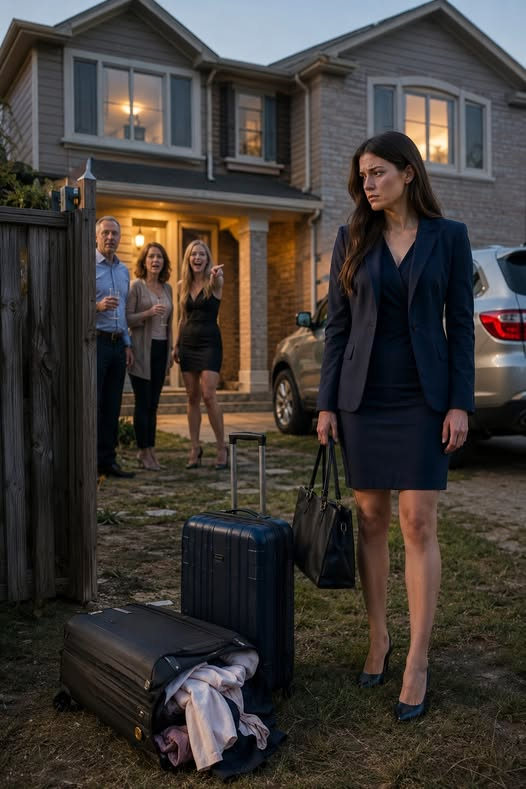
I stood in my parents’ backyard, still wearing the navy dress I had put on nearly twenty hours earlier in Singapore, and read those six words twice.
Then a third time.
Not because I misunderstood them.
Because I recognized the handwriting.
Brooke.
My younger sister had always pressed too hard with a pen. Even as a child, her letters left impressions on the next three pages.
Now those same angry grooves ran beneath a sentence announcing that I apparently no longer belonged in my own family.
One suitcase stood upright beside the gate.
The other lay on its side in the grass, its zipper broken, my clothes spilling through the opening.
I had shipped that suitcase home a week earlier after finishing a two-month commercial redevelopment project overseas.
Someone had opened it.
Several things were missing.
One wheel was caked in mud.
Through the living-room curtains, I could see warm light.
Someone laughed.
Glasses clinked.
The smell of grilled steak drifted through the open window.
They were all inside.
Mom.
Dad.
Brooke.
And probably Brooke’s boyfriend, Evan, judging from the silver SUV in the driveway.
Three days earlier I had sent everyone my flight number.
Mom replied with a heart.
Dad wrote, Drive safe from the airport.
Brooke ignored the message.
No one had forgotten I was coming.
My humiliation had been scheduled.
For a few seconds, I imagined storming inside.
I imagined slamming Brooke’s note on the kitchen counter.
I imagined reminding Dad who had covered the mortgage when his company nearly collapsed.
I imagined reminding Mom who had paid the property taxes the year she spent almost every dollar helping Brooke escape another “temporary crisis.”
I imagined finally saying everything I had swallowed for years.
Then I heard Brooke through the open window.
“She’ll make a whole production out of it,” she said.
My body went still.
Mom murmured something.
Brooke laughed.
“Just don’t engage.”
Then came the sentence that changed everything.
“She always comes back. Where else would she go?”
Something cold and clear settled inside me.
They didn’t think I stayed because I loved them.
They thought I stayed because I had nowhere else.
That was their mistake.
I folded the note carefully and slipped it into my handbag.
Then I picked up both suitcases.
No screaming.
No knocking.
No tears.
I walked through the gate, put everything into my rental car, and drove away.
No one came outside.
No one called my name.
The apartment was twenty-eight minutes away, above a closed tailor shop near the river.
Nobody in my family knew it existed.
I had rented it almost a year earlier through a small holding company when I finally began preparing for the possibility that one day I would need somewhere that belonged only to me.
It was modest.
One bedroom.
Gray laminate flooring.
Bare white walls.
A narrow kitchen.
Three bottles of water in the refrigerator and a jar of mustard that had expired months ago.
But when I put the key into the lock, it turned.
And when the door closed behind me, nobody could throw me out.
I sat at the small kitchen table and opened my laptop.
My family thought the apartment was the secret.
It wasn’t.
The apartment was simply where I kept the larger secrets.
I opened a folder named CEDAR.
Inside were mortgage records, ownership documents, insurance policies, account statements, loan guarantees, and copies of financial arrangements my parents had barely understood when they signed them.
Years earlier, Dad’s construction company had suffered a devastating cash-flow crisis.
Two major clients had gone bankrupt within months.
Banks stopped extending credit.
Dad was days away from losing both the company and the house.
I stepped in.
Quietly.
I was twenty-nine then, doing far better professionally than my family realized.
I created Cedar Grove Holdings, paid the overdue balance on the house, assumed the mortgage, and leased the property back to my parents for a symbolic amount.
Dad hated discussing money, so he signed where his attorney told him.
Mom simply said, “You saved us.”
Brooke was too busy complaining that nobody could help with her car payment.
Over time, everyone forgot the technical details.
Everyone except me.
Then there was Dad’s business.
When the bank threatened to call its loan five years ago, I guaranteed the debt through another company I controlled.
Again, Dad signed.
Again, I rescued him.
Again, the family treated it as though some invisible force had fixed everything.
That invisible force had always been me.
I stared at Brooke’s message on my phone.
Where are you?
Then:
Mom says your stuff is gone.
Then:
Don’t be dramatic.
I almost laughed.
Instead, I made the first phone call.
Then the second.
Then the third.
I didn’t destroy anything.
I didn’t take anything that wasn’t legally mine.
I simply stopped protecting people who had just demonstrated how little protection they thought I deserved.
By 11:42 p.m., I had suspended every optional family payment tied to my personal accounts.
Brooke’s car insurance.
Her phone plan.
The emergency credit card Mom kept “for household needs.”
Two subscriptions.
The landscaping service.
The storage unit.
And several recurring transfers Dad had apparently forgotten were mine.
Then I sent instructions to my attorney.
I slept better that night than I had in years.
At 7:16 the next morning, someone pounded on my door.
“Rachel!”
Brooke.
I checked my phone.
Seventeen missed calls.
Twenty-six unread messages.
Dad’s voice came next.
“Rachel, open the door.”
I walked to the entrance and opened it.
Brooke stood closest, still wearing yesterday’s clothes.
Mom’s eyes were swollen.
Dad held papers in one shaking hand.
Beside them stood my attorney, Nathan Cole.
Brooke shoved her phone toward me.
“What did you do?”
I looked at the screen.
Her insurance portal showed a cancelled autopay.
Her phone service had sent a warning.
Then I looked at Dad.
“Good morning.”
“Don’t play games,” he snapped. “Nathan says something about the house.”
Nathan opened his folder.
“Mr. and Mrs. Carter, the Willow Creek property is legally owned by Cedar Grove Holdings.”
Brooke frowned.
“So?”
Nathan continued.
“Ms. Carter is the sole owner of Cedar Grove Holdings.”
Silence.
Mom stared at me.
Dad shook his head.
“No. The house is mine.”
“The property was transferred twelve years ago during the refinancing settlement,” Nathan said. “You retained occupancy under a family lease.”
Dad’s face reddened.
“That was temporary.”
“No,” Nathan replied calmly. “It was not.”
Brooke looked at me.
“You own the house?”
I said nothing.
Her mouth fell open.
Then anger came rushing back.
“You let us think it was Dad’s?”
“I never told you that.”
“You never corrected us!”
“Why would I? You were living there for almost nothing.”
Dad stepped forward.
“Rachel, whatever point you’re trying to make—”
“I’m not making a point.”
I met his eyes.
“I came home and found my belongings in the yard.”
Mom whispered, “Brooke said you were moving.”
Brooke spun toward her.
“Mom!”
I looked at my mother.
“You believed her?”
Mom started crying.
“She said you wanted your room cleared because you were taking another international assignment.”
I reached into my handbag and unfolded the note.
Then I handed it to her.
Mom read it.
Her face changed.
Dad took it next.
Brooke’s confidence flickered.
“It was just a note.”
Dad turned to her.
“You wrote this?”
She crossed her arms.
“She’s never there! Evan and I need space. She has money. She could live anywhere.”
That sentence nearly made me smile.
Because finally, she had said the quiet part out loud.
Nathan cleared his throat.
“There is another matter.”
Dad looked at him.
Nathan removed a second document.
Across the top was the name of Dad’s company:
CARTER & SONS DEVELOPMENT.
Dad went pale.
“What is that?”
“The loan guarantee.”
Brooke rolled her eyes.
“What does that have to do with Rachel?”
Nathan answered.
“Everything.”
Dad sat down without being invited.
Years earlier, when his business was collapsing, I had guaranteed a line of credit worth $1.8 million.
The bank had agreed only because my holding company provided collateral.
Dad’s business recovered.
But he had never refinanced independently.
He had simply continued operating under the guarantee.
Meaning that once I withdrew from the arrangement, the bank could require new collateral.
Dad rubbed both hands over his face.
“How long do I have?”
“Thirty days,” Nathan said.
Mom gasped.
Brooke immediately looked at me.
“You can’t do this.”
I stared at her.
“I already did.”
“You’ll destroy Dad’s company!”
“No. I stopped guaranteeing Dad’s company.”
“That’s the same thing!”
“No, Brooke. It isn’t.”
I had spent years confusing help with obligation.
That morning, the difference finally became obvious.
Dad looked devastated.
“Rachel, I didn’t put your suitcases outside.”
“I know.”
“Then why punish me?”
I paused.
“Because you were inside.”
His eyes lifted.
“You heard her say I wasn’t needed. You knew my things were in the yard. And you stayed inside.”
That hurt him more than shouting ever could have.
Mom covered her mouth.
Dad looked away.
The next two weeks were chaos.
Brooke called dozens of times.
When I blocked her, she created new numbers.
Her messages alternated between fury and desperation.
You’re ruining the family.
Dad can’t sleep.
Mom is sick over this.
I’ll put your room back exactly how it was.
Then:
Evan thinks you’re unstable.
That one made me laugh.
I moved permanently into the apartment and hired movers to collect what remained of my belongings.
Dad requested meetings.
Mom sent apologies.
I declined both.
Not forever.
Just until I could hear their voices without immediately becoming the person who fixed everything.
Then something unexpected happened.
Dad found outside financing.
A local investor agreed to replace my guarantee.
I was genuinely relieved.
The house issue was more complicated, but I offered my parents six months to relocate or negotiate a proper purchase.
Brooke, however, refused to leave.
“This is my childhood home,” she announced during a family meeting Nathan arranged.
“So was it mine,” I replied.
“But you don’t live there.”
“Neither does the bank that holds your credit card.”
She glared at me.
Evan sat beside her, silent.
He had barely spoken during the entire meeting.
Then Nathan slid a final packet across the table.
“I need everyone to review this.”
I frowned.
This wasn’t one of my documents.
“What is it?”
Nathan looked at Dad.
Dad looked at Mom.
Brooke suddenly went rigid.
That was the first moment I realized something was wrong.
Nathan said, “While reviewing the property records, we found a lien application submitted four months ago.”
“A lien?” I asked.
“An attempted home-equity transaction.”
My stomach tightened.
“That’s impossible. Nobody can borrow against Cedar Grove without authorization.”
“Correct.”
Nathan turned the paper toward me.
“There was authorization.”
I looked down.
My name appeared on the document.
Rachel Carter.
Underneath it was a signature.
A very convincing imitation of mine.
I stared at it.
“What is this?”
Brooke stood abruptly.
“I’m leaving.”
Dad blocked her path.
“No.”
Evan lowered his head.
Nathan continued.
“The application was never completed because the lender discovered inconsistencies in the ownership structure.”
I looked at Brooke.
“You forged my signature?”
She said nothing.
Mom whispered, “Brooke…”
“It wasn’t like that!”
Brooke’s voice cracked.
“I was going to tell her.”
“Tell me what?”
She looked at Evan.
He wouldn’t meet her eyes.
Then she burst.
“We needed money!”
“For what?”
“An investment.”
Dad stared at her.
“What investment?”
Brooke began crying.
“Evan had an opportunity.”
Evan finally spoke.
“It wasn’t my idea.”
Brooke spun toward him.
“You said it was guaranteed!”
Nathan’s expression changed.
“Guaranteed by whom?”
No one answered.
I looked at Evan.
He looked terrified.
Then Nathan pulled another sheet from the packet.
Bank transfers.
Three of them.
Totaling $286,000.
My parents gasped.
Dad stood.
“Where did that money come from?”
Brooke wiped her face.
“My account.”
“You don’t have that kind of money,” Dad said.
Nathan looked at me.
And suddenly I understood why he had seemed uneasy when I arrived.
The money hadn’t come from Brooke.
It had come from an account in my name.
An old joint-access family reserve account I had opened years ago for emergencies.
I hadn’t checked it recently because there was rarely activity.
Except someone had been draining it for nine months.
Not Brooke.
The authorization code belonged to—
I looked at my mother.
She went white.
“Mom?”
Brooke stopped crying.
Dad turned slowly.
Mom sank into a chair.
“I was going to put it back.”
The room vanished around me.
“You took the money?”
Her hands trembled.
“Brooke said it was temporary.”
Brooke shouted, “You agreed!”
Mom began sobbing.
“She told me Evan’s investment would double it in six months. She said Rachel had so much she would never notice.”
I felt physically sick.
Dad looked as though someone had struck him.
“You stole from your daughter?”
Mom whispered, “I thought I was helping both my girls.”
“No,” I said.
My voice sounded far away.
“You helped one daughter steal from the other.”
Brooke slammed her palms on the table.
“Stop acting like you’re poor! You make more in a year than most people make in ten!”
The room went silent.
I stared at her.
There it was.
The philosophy beneath every betrayal.
Because I had more, taking from me somehow wasn’t theft.
Nathan began gathering the papers.
“I strongly recommend we stop this discussion until—”
“No.”
A voice came from the doorway.
Evan.
He had stood up.
His face was gray.
“No. She needs to know everything.”
Brooke stared at him.
“Evan, shut up.”
He reached into his jacket.
Brooke lunged.
“Don’t!”
Dad grabbed her arm.
Evan placed a sealed envelope on the table.
My name was written across it.
I didn’t recognize the handwriting.
“What is that?”
Evan swallowed.
“The investment was never real.”
Brooke screamed.
“SHUT UP!”
Mom froze.
Evan looked directly at me.
“Brooke didn’t need the money for an investment.”
He pushed the envelope closer.
“She needed it because someone was blackmailing her.”
Nathan’s eyes narrowed.
“Who?”
Evan said nothing.
I opened the envelope.
Inside were photographs.
Old photographs.
My father.
My mother.
A hospital.
And a newborn baby wrapped in a yellow blanket.
On the back of the first photograph was a date.
Thirty-four years earlier.
My birthday.
My hands began shaking.
“What is this?”
Nobody answered.
Then I found the document beneath the photographs.
A birth certificate.
But the mother’s name was not Linda Carter.
It was Rebecca Hayes.
I looked at my mother.
“Who is Rebecca?”
Mom broke.
A sound escaped her that I had never heard before.
Dad sat down as though his legs had failed him.
Brooke whispered, “This is what I was trying to keep buried.”
I looked between them.
“Who is Rebecca?”
Dad spoke.
His voice barely existed.
“Your mother’s sister.”
I stared at him.
“Aunt Rebecca died before I was born.”
Mom shook her head.
“No.”
My heart slammed against my ribs.
Dad closed his eyes.
“She died giving birth to you.”
The room tilted.
I gripped the edge of the table.
“No.”
Mom reached toward me.
I stepped back.
She stopped.
Dad continued.
“Rebecca was nineteen. Your biological father disappeared when she got pregnant. We planned to raise you from birth.”
My vision blurred.
“So you’re not my mother?”
Mom cried harder.
“I am your mother.”
“You lied to me for thirty-four years.”
“We raised you!”
“And Brooke knew?”
Nobody answered.
I looked at her.
“When?”
Brooke’s face crumpled.
“Two years ago.”
“How?”
“Grandma’s storage boxes.”
Suddenly everything made horrible sense.
Brooke’s resentment.
The sudden intensity of it.
The way she had begun calling me “basically a guest” whenever she was angry.
The way she kept saying the house belonged to “real family.”
But there was still one question.
“Who was blackmailing you?”
Evan looked at Brooke.
She shook her head frantically.
“Don’t.”
I opened the last folded page.
It was a handwritten letter.
From my grandmother.
Addressed to me.
And beneath the letter was a copy of a trust.
My eyes moved over the words.
Then stopped.
The house wasn’t the real inheritance.
Neither was Dad’s company.
My biological mother, Rebecca, had inherited shares in a regional land-development company from my grandfather.
When she died, those shares passed to me.
My parents had placed them in trust.
Over thirty-four years, mergers and land sales had transformed their value.
I looked at Nathan.
He had already calculated it.
“Approximately eighty-six million dollars,” he said quietly.
Brooke made a broken sound.
I stared at her.
That was why someone had been blackmailing her.
Not to keep the adoption secret.
To keep me from discovering the trust.
“Who?” I whispered.
Brooke covered her face.
Evan answered.
“Your uncle.”
My father looked up sharply.
“My brother?”
Evan nodded.
“He found out Brooke knew. He told her if Rachel learned about the trust, he’d lose control of the company shares he’d been managing illegally for years.”
Nathan went completely still.
Dad whispered, “Oh my God.”
Brooke sobbed.
“He said if I kept Rachel distracted and helped him replace her signature on some documents, he’d pay me.”
I stared at her.
“You threw my things into the yard because he told you to?”
She shook her head.
“No.”
Tears streamed down her face.
“That part was me.”
The honesty hurt more than another lie.
She looked at me desperately.
“I hated that everything always worked out for you. I thought you were the favorite. Then I found out you weren’t even—”
She stopped.
“Even what?”
She looked down.
“Even Mom and Dad’s biological daughter.”
My chest tightened.
Mom stood.
“She is our daughter.”
Brooke laughed bitterly through her tears.
“Then why did you spend thirty-four years lying to her?”
Nobody had an answer.
I looked around the table.
At my parents.
At my sister.
At the forged signatures.
At the stolen money.
At the photographs of a nineteen-year-old woman I had never known holding me for a few minutes before she died.
Then I looked at the note I had carried in my handbag since the backyard.
YOU ARE NOT NEEDED HERE ANYMORE.
Slowly, I placed it on top of the trust documents.
Brooke stared at it.
“I’m sorry.”
I believed she meant it.
But apologies do not reverse choices.
I stood.
Nathan asked quietly, “Rachel, what do you want to do?”
Everyone looked at me.
Thirty-four years of secrets.
Twelve years of financial rescue.
Nine months of theft.
One forged signature.
One backyard.
One note.
I should have wanted revenge.
Instead, I felt something stranger.
Freedom.
“I want an independent forensic audit of the trust,” I said. “Every transaction. Every property. Every signature.”
Nathan nodded.
“And the criminal matters?”
I looked at Brooke.
Then Mom.
Then Dad.
“Follow the evidence.”
Brooke collapsed into her chair.
I picked up the photograph of Rebecca holding me.
For the first time in my life, I saw my own eyes in someone else’s face.
At the door, Dad called my name.
“Rachel.”
I turned.
He was crying.
“You were needed.”
I looked at him for a long moment.
“That was never the question.”
Then I left.
Six months later, my uncle was indicted for fraud, embezzlement, and falsifying trust documents.
Mom repaid every dollar she had taken.
Dad refinanced his company without me and eventually bought the family house back from Cedar Grove at fair market value.
Brooke accepted a plea agreement for her role in the forged loan application.
Evan testified.
And I finally learned the truth about Rebecca.
She had named me Rachel before she died.
She had also written one sentence in a letter my grandmother hid away for decades:
“Please make sure she grows up knowing that she was wanted.”
I read that sentence sitting alone in my apartment above the abandoned tailor shop.
And I cried harder than I had cried the day I found my suitcases outside.
Not because I had lost a family.
Because after thirty-four years, I finally understood something they had never been able to teach me.
Being needed was never the same as being loved.
Being useful was never the same as belonging.
And sometimes the cruelest rejection of your life is simply the door that finally forces you to discover the truth waiting on the other side.