Part 1
I walked into my daughter’s hospital room and watched doctors confirm a broken arm, a concussion, and bruises covering her body—then I walked straight into the principal’s office and found out the boy who did this was my ex-husband’s son, and that’s when everything got worse. Richard sat there like he owned the place, feet on the desk, laughing at me, saying “like mother, like daughter, both failures,” then he threw a five-thousand-dollar check at me and told me to buy myself something decent to wear. His son Max stood up, shoved me, and bragged “my dad pays for this school, I make the rules here,” and when I asked him point blank if he pushed my daughter down the stairs, he smiled and said yes, no fear, no shame, like he’d never faced a consequence in his life. The principal just stared at the floor, too scared of losing a donor to say a word, while Richard kept bragging that the police chief golfs with him and he can buy every lawyer in the city, leaning back and telling me I was powerless. So I reached into my bag, and the second I opened it, the room went silent—because what they didn’t know is that I’m not just a single mom they could intimidate, and the child they hurt isn’t just any student, and within minutes the evidence was secured and the calls were already being made, and no amount of money or arrogance was going to stop what came next.
Part 2
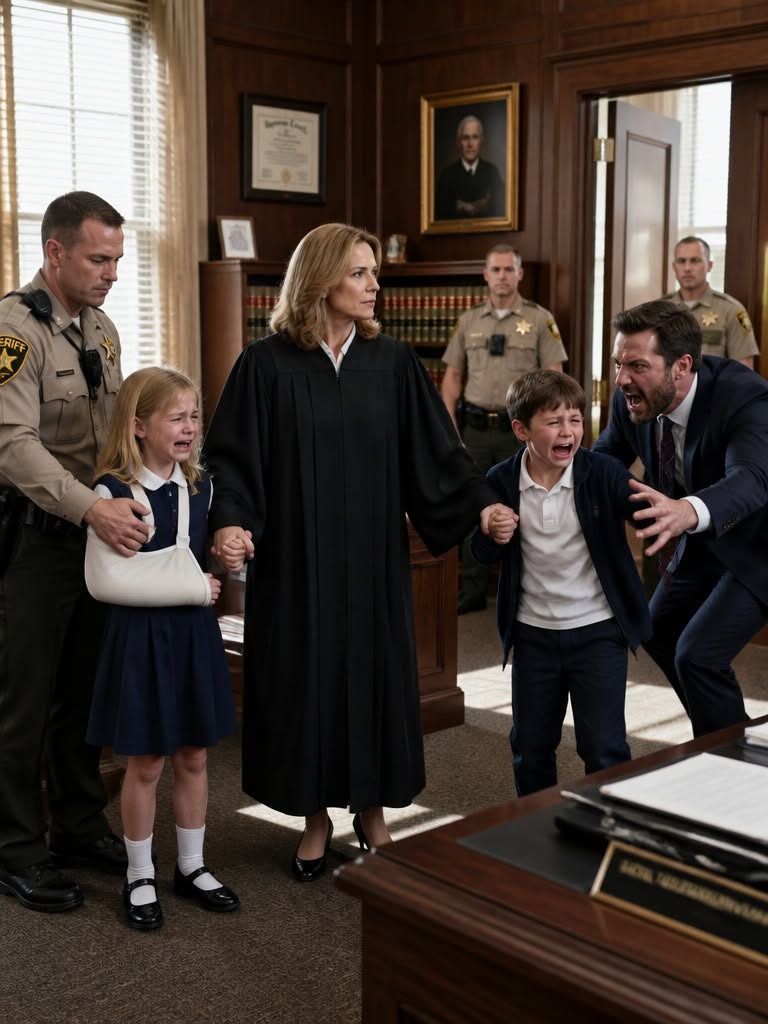
The black leather wallet hit the desk with a soft thud, and inside it was the gold badge and ID that read Chief Judge Elena Sterling, Family and Criminal Division. Richard’s checkbook fell out of his hand. The principal’s face drained of color so fast I thought he might pass out right there in his chair. Max’s smirk vanished, replaced by the blank confusion of a kid who’d never once been told no and didn’t know what to do when reality finally caught up to him. “You’re going to want to sit back down,” I said quietly, and for the first time in fifteen years of knowing Richard Sterling, I watched him actually do what I told him. I explained, slow and calm, that the hospital had already filed a mandatory report the moment my daughter came in with injuries consistent with an assault, that the school’s hallway cameras had already been subpoenaed before I ever walked through that door, and that Max had just confessed, out loud, in front of the principal, with no lawyer and no parent stopping him. Richard’s golf buddy in the police department wasn’t going to matter, because this wasn’t a case I was hearing, it was a case I was reporting, and there’s a very clear line between judge and victim’s mother that even his money couldn’t blur. I called the resource officer stationed two doors down, and within minutes Max was being escorted to a separate room while child services and the district superintendent were both notified, because assault causing bodily harm to a minor doesn’t stay quiet just because a donor’s name is on the gymnasium wall. Richard finally dropped the act, his voice cracking as he asked if we could “handle this privately, for the kids’ sake,” and I told him the time for handling things privately ended the moment his son shoved my daughter down a flight of stairs and bragged about it. As I walked out to go back to my daughter’s hospital room, I heard the principal already on the phone with the school board, and I knew that no matter how this played out in the weeks ahead, one truth had finally landed in that office: money can buy a lot of things, but it can’t buy your way out of the truth when the truth is sitting right in front of you with a badge in her hand.
Part 3
The school called an emergency board meeting that same night, and word spread through the parent group chats faster than the district could control it, because three other families came forward within hours saying Max had bullied their kids too, only they’d been too afraid of Richard’s money to file a complaint until they saw someone finally stand up to him. The superintendent suspended Max immediately pending a full investigation, and the hallway footage, once pulled, showed exactly what I already knew: a deliberate shove on the stairwell landing, not a scuffle, not an accident, a clear and isolated act with my daughter’s back turned. Richard tried calling in every favor he had, lawyers, board members, even reaching out to a state senator he’d donated to, but a confessed assault on video with a documented broken arm and concussion doesn’t leave much room for influence to work its usual magic. Child Protective Services opened a file on the household after learning this wasn’t an isolated incident of Max’s behavior going unchecked, and the detective assigned to the case told me privately that Richard’s golf friendship with the chief wasn’t going to shield him from a paper trail this clean. Two weeks later, Max was formally charged in juvenile court with assault, and the judge presiding, a colleague who recused herself from any conflict given my position, ordered him into a structured accountability program along with mandatory counseling, while the school’s board voted to remove the Sterling family’s name from the gymnasium and reviewed every prior complaint that had been quietly buried over the years. My daughter healed slowly, cast off after six weeks, but the thing that stuck with her longest wasn’t the pain, it was watching her mother refuse to be intimidated, and she told me one night that she wanted to be a judge too, “so nobody ever thinks they can buy their way out of being kind.” Richard never apologized, not really, but the silence from him afterward said more than any words could, because for the first time in his life, his money didn’t make the problem disappear, the truth did.
A year later, the gymnasium that once bore the Sterling name now had a plaque dedicated to student safety, funded by a settlement Richard was ordered to pay after the civil suit I filed on my daughter’s behalf, every dollar of which went straight into her college fund and a scholarship for kids who’d been bullied and never had anyone believe them. Max completed his accountability program, and to his credit, he wrote my daughter a real apology letter, no excuses, no parent’s lawyer hovering over his shoulder, just a kid finally understanding what he’d done, and she chose to forgive him, because she’s a better person than I was at her age. Richard and I still cross paths at school events sometimes, and he doesn’t joke anymore, doesn’t toss checks at people, doesn’t lean back like he owns the room, because somewhere along the way he learned that respect isn’t something you can write into existence. My daughter went back to school that fall with a new cast-free arm and a story she’d tell for years, not about being a victim, but about watching her mother stand in a room full of people who underestimated her and refuse to back down. I think about that day in the principal’s office often, not because of the wallet or the badge, but because of the moment right before I opened it, when I was just a scared mother who almost let fear talk her out of fighting for her child. If there’s one thing I want anyone reading this to take away, it’s that you don’t need a title or a badge to stand up for your kid, you just need to refuse to be small in a room that’s betting you will be, because the people who hide behind money and power are usually the first ones to fold when someone finally stops being afraid of them.
A single mother rushes her daughter to the hospital after a brutal school bullying incident, only to discover the attacker is her ex-husband’s son. Confident that his wealth and connections make him untouchable, her ex mocks her, throws money at the problem, and lets his son openly admit to the assault without a flicker of remorse. But the mother isn’t just another parent he can intimidate, she’s a Chief Judge, and what follows is a methodical, evidence-backed reckoning that no amount of money or influence can stop. The story closes with accountability, healing, and a powerful reminder: true power isn’t measured in wealth or connections, it’s measured in integrity and the courage to stand firm when someone bets you’ll back down. The lesson is simple but timeless, never underestimate someone based on how replaceable you think their silence is, because the quietest person in the room might be the one holding all the cards.