Part 1
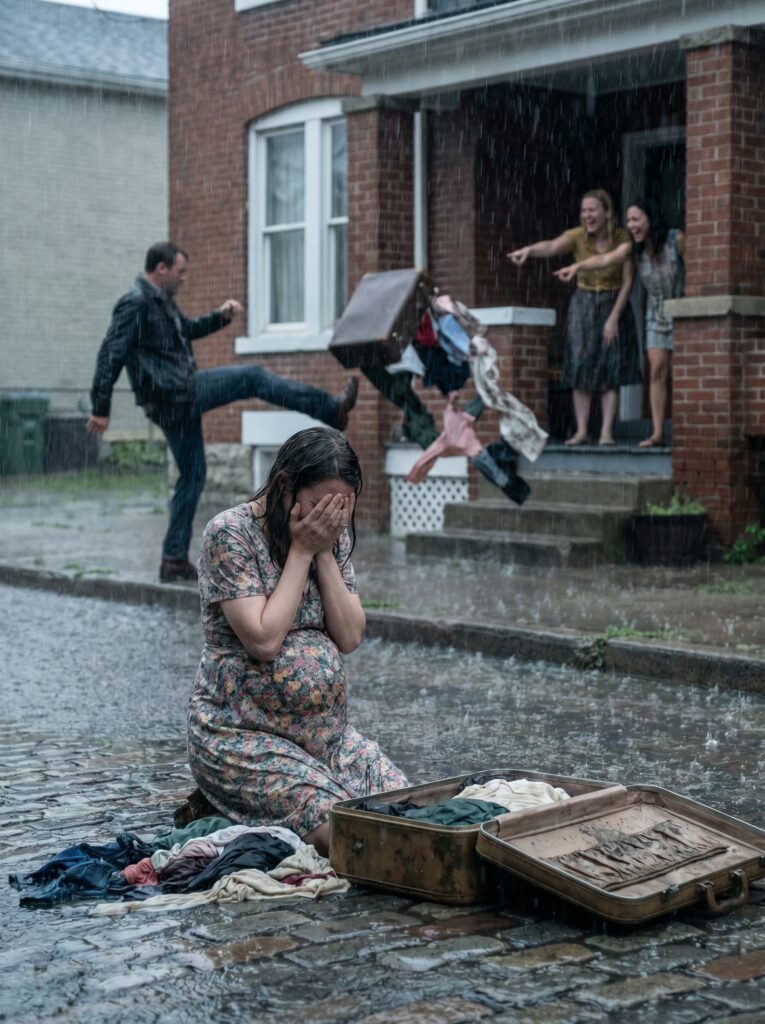
My husband threw me out in the rain while I was six months pregnant and his mistress stood next to him laughing. His mother walked through that same rain, looked me dead in the eyes, and spat in my face. I did not scream. I did not beg. I did not give either of them the satisfaction of a single tear. I simply wiped my face, picked up my mother’s keepsake box from the wet pavement where my burst suitcase had scattered everything I owned, placed my hand on my belly, and made one quiet phone call. “Dad. It’s over. Come get me. And bring legal.” Fifteen minutes later, black SUVs lined the entire street and the color drained from my mother-in-law’s face the moment she heard the voice on that phone because every person in America recognizes that voice. For three years I had hidden who I was because I wanted a husband who loved ME, not the empire behind my name. I dressed simply, avoided my past, never used my birth name, and let Ethan Carter believe he had married an ordinary scholarship girl with no money and no connections. He called me nothing. His mother said I never belonged. His mistress laughed at a pregnant woman standing in the rain. What none of them knew was that the quiet woman who washed dishes while they threw insults was Olivia Bennett, the only daughter of William Bennett, billionaire founder of the Bennett Group, owner of banks, hospitals, real estate towers, and investment firms across the entire country. Ethan had spent three years looking down at a woman whose family owned the kind of world he was desperately trying to climb into. My father warned me once: men like him love what you provide, never who you are. I did not listen then. I am listening now. And when those SUVs pulled up and the lawyers stepped out into the rain, the man who called me nothing finally understood whose world he had actually been living in all along.
Part 2
Everyone on that street stopped what they were doing the moment those SUVs pulled up because seven black vehicles arriving simultaneously in a quiet suburban Chicago neighborhood is not something neighbors forget quickly. Ethan stood frozen on the driveway with his mouth slightly open and Vanessa’s hand slowly slid off his arm like she was quietly recalculating every decision she had made in the last six months. My father’s head of legal, Marcus Webb, stepped out first, tall and unhurried in a charcoal suit that probably cost more than Ethan’s monthly salary, and he didn’t even look at Ethan when he walked past him, he walked directly to me, opened an umbrella over my head, and said quietly, “Mr. Bennett sends his love and asks that you stay warm, Miss Olivia.” And that was the moment everything shifted because Ethan heard the name. Miss Olivia. Not Mrs. Carter. Not his wife. Not the woman he had just thrown into the rain. My father’s people didn’t acknowledge Ethan as a husband. They acknowledged me as a Bennett. Ethan stepped forward with his chest out the way men do when they are terrified but refuse to show it. “Look, I don’t know what kind of show this is but Olivia and I are in the middle of a private matter and I’m going to need all of you to leave my property.” Marcus Webb finally looked at him. Just once. Briefly. The way you glance at something unimportant on the sidewalk. “Mr. Carter,” he said calmly, “this property was purchased using a Bennett Group subsidiary account three years ago as part of a private family arrangement. Miss Olivia’s name has been on the deed since closing. So respectfully, sir, this is not your property to ask anyone to leave.” The sound Diane Carter made was not quite a gasp and not quite a word. It was the sound of a woman realizing in real time that the daughter-in-law she had spat on owned the house she was standing in front of. Ethan turned to me slowly. “That’s not true,” he said, but his voice had lost all its edges. “Olivia, tell them that’s not true.” I looked at him the same way I had looked at him in the rain, calm, steady, completely unbothered, and I said nothing because there was nothing left that needed saying. Vanessa, who had been quiet for the first time since I met her, pulled at Ethan’s sleeve and whispered something in his ear and whatever she said made his face go a shade of pale I had never seen on him before. My father’s second attorney, a woman named Claire Shen who I had known since I was twelve years old, stepped forward with a folder and held it out toward Ethan with two fingers the way you hand something to someone you have very little patience for. “These are the preliminary dissolution documents, Mr. Carter. Given the circumstances of this evening, which have been documented, witnessed, and recorded, Mr. Bennett’s legal team will be pursuing the most comprehensive settlement review permitted under Illinois family law including asset tracing, property origin verification, and a formal review of all investment accounts opened during the marriage.” Ethan stared at the folder. He didn’t take it. “Recorded?” He looked around the street suddenly, at the SUVs, at the quiet men standing near them, at the small devices that were not phones and not cameras but something between both, and his jaw tightened. “You had people watching me?” I finally spoke. “My father has kept eyes on me since the day I married you,” I said. “Not to spy on your business, Ethan. To make sure I stayed safe. Because he knew something about you that I refused to believe.” Diane sat down on the porch steps because her legs had apparently decided they were done holding her up. Vanessa was already walking back toward the house quietly, her wine-and-quiet-evening evaporating in the Chicago rain. And Ethan stood on a driveway that was never legally his, in a house that had always been mine, holding dissolution papers he never expected to see, finally understanding that for three years he had not been leading anyone. He had been a guest in a life he mistook for his own. My father arrived in the last SUV. He didn’t rush. He stepped out slowly the way powerful men do when they have nothing to prove, walked directly to me, pulled me into his arms without saying a word, and held an umbrella over both of us. Then he looked at Ethan Carter once, just once, the same way you look at a very small thing standing in a very big storm, and said simply, “My daughter is going home now.” And we left. We left the scattered clothes on the driveway, the woman who spat on me sitting on the porch steps, the man who called me nothing standing in the rain, and the house that was always mine anyway. I didn’t look back. My mother’s ring was on my finger. My father’s hand was on my shoulder. And somewhere in the back of that warm, dry SUV, my baby kicked for the very first time.
Part 3
I felt that kick and I pressed my hand flat against my stomach and I made a silent promise to my daughter that she would never spend a single day of her life around people who required her to make herself small in order to be loved because I had spent three years doing exactly that and I was done. My father felt me tense and looked down without saying anything and then looked out the window at the wet Chicago streets sliding past and after a long silence he said, “I should have come sooner.” I told him he came exactly when I called. He shook his head slowly and said, “I should have come before you ever had to call.” We rode the rest of the way in the kind of quiet that only exists between a father and daughter who have already said the important things and are now just sitting inside the truth of them together. The Bennett family home outside Chicago is not what people imagine when they hear the name Bennett Group. It is not a mansion designed to intimidate. It is large and warm and old in the way that homes are old when generations of the same family have lived and grieved and celebrated inside the same walls and my grandmother planted every rosebush in the front garden herself forty years ago. When the SUV pulled through the gates I felt something release in my chest that I had been holding so tightly for so long that I had forgotten it was there. My father’s housekeeper, a woman named Rosa who had known me since I was four years old and who expressed love primarily through food and mild scolding, was standing at the front door with a blanket and a look on her face that communicated without a single word that she already knew everything and had opinions about all of it. She wrapped the blanket around my shoulders, put both hands on my face, looked at me for a long moment, then looked at my stomach and said, “She is going to be so beautiful,” and I finally cried. Not because I was broken. Not because Ethan had won anything. I cried because I was warm and safe and surrounded by people who had loved me before I was useful to anyone and would love me long after and sometimes that realization after a long time of going without it simply opens something in you that has no choice but to pour out. My father gave me space to cry. Rosa brought soup. The family doctor arrived within the hour, sent by my father before we even reached the house, and confirmed that despite everything the baby was perfectly healthy, heart strong, movement good, and that I needed rest, hydration, and to stay away from stress, which my father took as a formal medical directive to handle everything else himself so that I would not have to think about Ethan Carter for a single moment longer than necessary. What I did not know while I was sleeping in my childhood bedroom that night with Rosa checking on me every two hours was that Marcus Webb and Claire Shen had not gone home after they left the driveway on Maple Street. They had gone directly to the Bennett Group offices downtown and they worked through the entire night because my father had given them one instruction and one instruction only: find everything. And there was, it turned out, quite a lot to find. Ethan Carter had spent three years believing he was cleverly building his own financial empire quietly alongside his marriage and what he had actually been doing was leaving a very clear paper trail that two of the sharpest financial attorneys in the country were now following with great focus and unlimited resources. The investment accounts he opened six months into our marriage using seed capital he told me came from a bonus. The property he purchased in Vanessa’s name fourteen months ago using funds routed through a shell account connected to a joint asset. The clients he quietly redirected from the firm where he worked to a private advisory he registered without disclosure. The life insurance policy adjustment he filed eight weeks ago that my father’s team found and that caused Claire Shen to pick up the phone at two in the morning and call Marcus and say only, “You need to see this.” I did not know about that policy yet. My father made sure of that. He wanted me to sleep and so I slept and while I slept the quiet machinery of the Bennett family moved in the way it had always moved when someone threatened what my father loved, without noise, without anger, without any wasted motion whatsoever, just absolute and total and completely inevitable consequence. Ethan Carter woke up the following morning believing that the worst thing that had happened to him was losing a house and facing a divorce settlement. He made coffee in the kitchen of a property that Claire Shen had already flagged for asset review. He checked his investment accounts from a laptop that a forensic financial team had already begun building a case around. He called Vanessa who did not answer because Vanessa had received a very quiet visit very early that morning from a Bennett Group attorney who explained to her in precise and unemotional terms exactly what her legal exposure looked like as a knowing participant in the financial arrangements her boyfriend had been making using marital assets and Vanessa, who was many things, was not unintelligent and had immediately called her own lawyer and stopped answering calls from Ethan entirely. He called his mother next. Diane Carter had not slept. She had spent the night sitting in her kitchen going through thirty-six months of memories and reexamining every single interaction she’d had with her daughter-in-law through the lens of what she now knew to be true and the picture that assembled itself was not a comfortable one. She had spat on a woman whose family could dismantle everything the Carter name had ever built. She had called her worthless in front of witnesses. She had celebrated her humiliation out loud. And the woman she had done all of this to had not screamed, had not threatened, had not even raised her voice. She had made one phone call and gone home. Diane understood now that the silence had never been weakness. The silence had been patience. And somewhere across the city in a warm bedroom surrounded by her grandmother’s quilts and the smell of Rosa’s cooking drifting up from downstairs, I was resting, and my daughter was kicking, and I was no longer anyone’s secret….Three days after I left that driveway I received a phone call from a number I did not recognize and when I answered it was Diane Carter and her voice sounded like something that had been wrung out and hung to dry and she said, “Olivia, I need to speak with you,” and I sat with the phone in my hand for a moment looking out the window at my grandmother’s rosebushes still holding their shape in the late autumn cold and I said, “Mrs. Carter, there is nothing you need to say to me that my attorneys cannot receive in writing,” and I ended the call without anger, without satisfaction, without any feeling at all really, because the truth about healing that nobody tells you is that it doesn’t feel like victory, it feels like finally putting down something extraordinarily heavy that you carried for so long you forgot it wasn’t supposed to be yours to carry. Ethan tried next. He showed up at the Bennett family gates on the fourth morning in a car that now felt very small against the stone pillars and the iron and the quiet men standing at the entrance who looked at him the way mountains look at weather, unmoved and entirely unbothered, and he asked to see me and my father’s head of security, a former federal agent named Daniel who had watched me grow up and taught me to play chess when I was seven, walked to Ethan’s window and said simply, “Miss Bennett is not receiving visitors,” and Ethan said, “She is my wife,” and Daniel looked at him calmly and said, “Mr. Carter, I would encourage you to speak with your attorney before making any further statements about your legal relationship to Miss Bennett,” and that was the end of that conversation. What happened next Ethan did not see coming because he had spent three years underestimating the woman he married and old habits are difficult to break even when the evidence against them is parked in seven black SUVs outside your house. Marcus Webb filed the dissolution petition on day five and attached to it was a financial disclosure document that was sixty-three pages long and detailed every account, every transfer, every shell entity, every redirected client, and every asset movement Ethan had made during the marriage and the number at the bottom of that document representing the total value of marital assets he had moved, concealed, or misappropriated was large enough that when Ethan’s own attorney saw it he reportedly sat back in his chair and said nothing for almost a full minute. The life insurance policy adjustment my father had been protecting me from knowing about was on page forty-seven. Eight weeks before he threw me into the rain Ethan had quietly changed the beneficiary on a two million dollar policy, removed my name, and added Vanessa’s, and he had done it while I was six months pregnant, and when Claire Shen presented this to my father he had gone very still in the way that genuinely powerful men go still when they are deciding something, not performing calm but actually accessing it, and then he had said four words to Marcus, “Add it to everything,” and Marcus had nodded and added it to everything. Ethan’s firm placed him on administrative leave on day seven pending an internal review of the client redirection allegations that an anonymous filing had brought to their compliance department’s attention and I will not tell you who made that filing because I think you can already guess. Vanessa, who had retained her own attorney and was now fully cooperating with the financial review in exchange for a reduced personal liability agreement, confirmed in a signed statement that Ethan had told her fourteen months ago that his wife came from money but that she was, in his exact words, too naive to ever know how to use it against him. I read that line once and then I set the document down on my father’s desk and looked out at the garden and thought about the girl who had deliberately hidden her last name because she wanted to be loved plainly and simply and without the weight of what she came from and I felt sorry for her and proud of her at the same time because she had wanted something real and that desire was never the mistake, the mistake was believing that Ethan Carter was capable of offering it. My daughter was born on a Thursday morning in late winter in a private hospital suite filled with pale yellow flowers my father had ordered because I once told him when I was nine years old that yellow was the color that felt most like hope and he had never forgotten that. She was seven pounds and two ounces and she had my mother’s nose and my grandmother’s stubbornness already written plainly across her tiny furious face when they placed her in my arms and I looked at her and understood immediately that every single thing that had happened, the rain, the driveway, the spit, the suitcase bursting open on wet concrete, the three years of smallness, all of it had been the precise and necessary path to this exact moment and this exact person looking up at me like I was the entire world because to her I was. I named her Eleanor William Bennett, Eleanor for my grandmother and William for my father, and when my father held her for the first time he cried in the quiet private way that men who have spent their lives being strong cry, just one hand covering his eyes and his shoulders shaking slightly and Rosa standing behind him with her hand on his back and no one saying anything because nothing needed to be said. Ethan Carter accepted a settlement agreement six weeks after Eleanor was born. He signed over full legal rights to the Maple Street property, agreed to a financial judgment that his attorney had spent three weeks trying to reduce and succeeded in reducing only marginally, surrendered his stake in the private advisory firm which was subsequently dissolved following the compliance investigation, and accepted a formal legal finding regarding the life insurance policy that will follow his professional record in the financial industry for a very long time. He did not contest custody. He did not fight for visitation. He signed where Claire Shen pointed and left the conference room without looking at anyone and I was not in that room because I did not need to be because I had Marcus and Claire and my father and the sixty-three page document and the full weight of three years of documented silence and I was home with my daughter feeding her and watching her discover her own hands with the absolute seriousness that newborns bring to everything. Diane Carter wrote me a letter. A real one, on paper, in handwriting that looked like it had taken a long time to produce and several attempts to get right. She said she was sorry. She said she had been cruel to me for reasons that had nothing to do with me and everything to do with her own fear of what I represented, a woman her son chose over her own influence, and that she had projected that fear into cruelty and she was ashamed. She said she hoped Eleanor would have a good life. I read the letter twice, put it in the wooden keepsake box I had grabbed off the driveway in the rain, and closed the lid. Not because I was holding onto the pain. Because I had decided that her apology belonged to her, that she needed to have written it more than I needed to receive it, and that my healing was not dependent on what she did or didn’t feel in her kitchen at night. I had a daughter to raise. I had a name to pass on that meant something. I had rosebushes my grandmother planted and a father who ordered yellow flowers and a woman named Rosa who loved me through soup and scolding and I had three years of silence that had never actually been silence at all but rather the slow and patient accumulation of a woman who knew exactly who she was, who chose to love without armor, who stood in the rain without breaking, and who picked up her mother’s ring and made one phone call and changed everything. My name is Olivia Eleanor Bennett. My daughter is named after my grandmother and my father. The house on Maple Street has been converted into a transitional housing facility for pregnant women leaving unsafe situations and it operates under a foundation I established in my mother’s name and it has helped forty-seven women in its first year and it will help thousands more. I do not think about Ethan Carter. I think about Eleanor’s hands. I think about yellow flowers. I think about rain, sometimes, the way it washed everything clean that night on a driveway in a quiet suburban neighborhood outside Chicago while a man who called me nothing learned, too late and all at once, that the woman he had dismissed, belittled, spat on by proxy, and thrown into a storm was never ordinary, never powerless, never without resource, never without love, and never, not for a single moment in her entire life, nothing.
SHORT SUMMARY:
Olivia Bennett spent three years hiding her identity as the daughter of one of America’s most powerful billionaires because she wanted to be loved for who she was, not what she came from. She married Ethan Carter in good faith, endured three years of insults from his mother, and said nothing. Then one rainy night, six months pregnant, Ethan threw her suitcase into the street, stood beside his mistress, and let his mother spit in her face. He expected her to beg. Instead, she made one quiet phone call to her father, William Bennett, and whispered three words that changed everything. Seven black SUVs arrived within fifteen minutes. Lawyers followed. Sixty-three pages of financial evidence followed. Justice followed. Ethan lost his house, his career, his reputation, and everything he thought he had built. Olivia went home, had her daughter Eleanor, and turned the house that was always legally hers into a shelter for pregnant women in crisis. She never raised her voice. She never needed to.
THE LESSON WE CAN ALL LEARN:
The most dangerous person in any room is never the loudest one. It is the quiet one who already knows everything and is simply waiting for the right moment. So many of us have been made to feel small by people who mistook our gentleness for weakness, our silence for ignorance, and our patience for powerlessness. Olivia never fought back with words because she understood something that Ethan and Diane Carter never did, that real strength does not announce itself, it simply arrives, unbothered, unhurried, and completely inevitable. Do not be so busy underestimating the quiet people around you that you miss the moment they stop being patient. And if you are the one who has been standing in the rain, enduring what you should never have had to endure, holding yourself together when everything around you is falling apart, this story is for you. Your silence is not weakness. Your calm is not surrender. You are not nothing. You are simply not yet finished. And when your moment comes, like Olivia’s did, you will not need to scream. You will only need to make one call.