Part 1
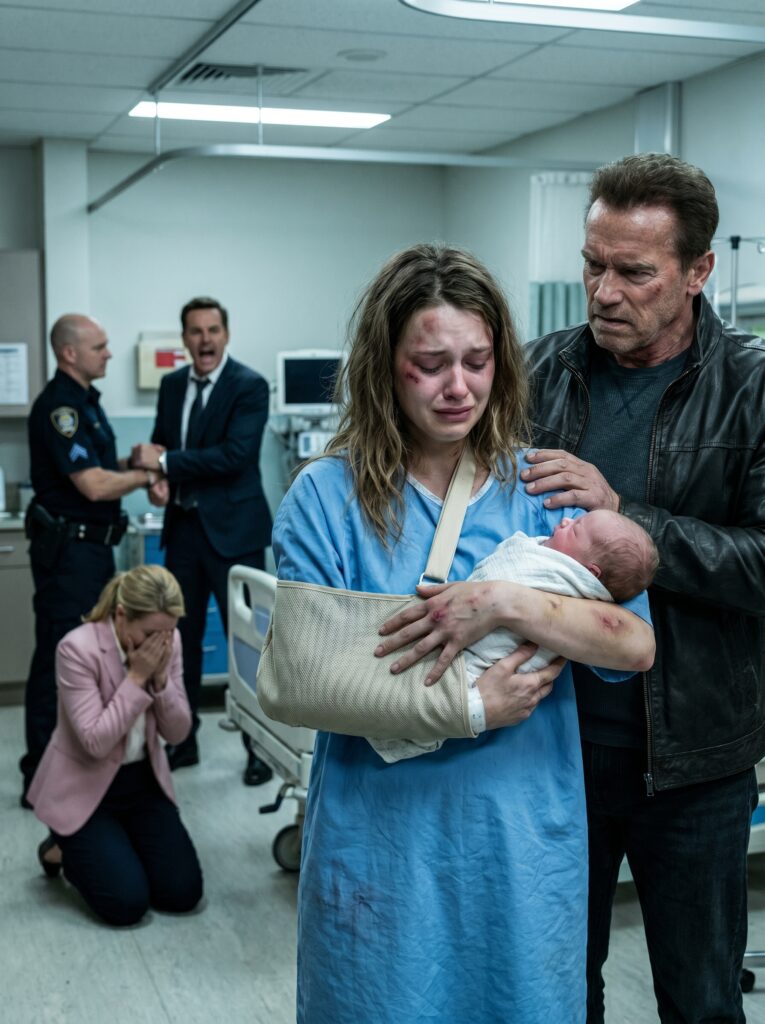
When my grandfather saw my newborn wrapped in a frayed blanket, he didn’t look at his face first. He looked at my worn-out clothes. Then his mouth tightened like I had dragged shame through his marble foyer. Victor Holloway, billionaire and patriarch, the kind of man who could ruin bankers before breakfast, stood beneath a chandelier worth more than my entire life and asked me one question: “Wasn’t $582,000 a month enough?” The room went dead silent. My aunt Patricia froze by the fireplace. My cousin Celeste gripped her champagne glass. My husband’s mother, Elaine, smiled just a little too quickly. Rain slid down the glass walls of Holloway House and I stood near the entrance in my faded gray coat, my newborn pressed against my chest, his tiny fist curled around one loose thread of my sleeve, and I looked my grandfather calmly in the eye and said, “I never received a single dollar.” His face didn’t shatter dramatically the way it does in movies. Just one small crack through the granite. He repeated himself slowly, like maybe he had misheard me, and I said it again, just as clearly. Behind him, Patricia’s eyes flickered toward Elaine. Celeste’s fingers tightened. And then my husband Adrian, the man who had not visited me once during the final month of my pregnancy, stepped forward with that handsome, poisonous smile and told the room I was just suffering from postpartum confusion. I almost laughed out loud. Three weeks ago I gave birth in a public clinic because the private hospital deposit had bounced. Two weeks ago my landlord taped an eviction notice to my door. One week ago Adrian sent me a message that said, “You should have been more grateful.” And now here they all stood in designer clothes, acting concerned, while I held our son in a secondhand blanket. My grandfather turned slowly toward Adrian and said he had wired support every month. Adrian never blinked. He smiled and said his mother had handled the details through the family trust. Elaine touched her pearls and suggested this was hardly the time. I kissed my baby’s forehead and told her it was exactly the time. What none of them ever knew was that before I became Adrian’s wife, before they started calling me the scholarship girl and the charity bride, I had spent years auditing financial crimes. I had copied every document. I had said nothing and built everything in silence while they starved me and called it gratitude. My grandfather didn’t say another word. He picked up his phone, told his assistant to call Mercer, Vale, and Roth immediately, raised one hand to stop Patricia mid-sentence, and said, “No one leaves.”
Part 2
No one moved. The only sound in the room was the rain against the glass and my baby’s soft breathing against my chest. Adrian’s smile didn’t waver but his eyes had changed. I had seen that look before, the first time I had caught a discrepancy in a client’s ledger years ago, that split second where a person realizes the ground beneath them is no longer solid. Elaine set her champagne flute down on the side table with a small careful click, the kind of movement that tries very hard not to look like panic. Celeste had gone completely still. Patricia was staring at her father like she was watching him become a stranger. Victor Holloway did not sit down. Men like my grandfather do not sit when they are threatened. They stand and they command and they make the room feel smaller until you forget that you were ever anything but afraid of them. He looked at me over the top of his phone, his assistant still on the line, and said, “Lena. How much do you know?” I shifted my son gently in my arms. “Everything.” That one word did more damage than a courtroom could have in an hour. Adrian laughed, and it was the worst sound I had ever heard from him because it was hollow, performed for an audience that was no longer watching him the way they used to. “She is bluffing,” he said. “She has been home with a newborn. She has no access, no resources, no—” “Adrian.” My grandfather’s voice was quiet. That was how I knew it was serious. Victor Holloway only went quiet when he had already decided something terrible. “Stop talking.” Adrian stopped. Elaine reached for his arm and he pulled away from her slightly, just enough for me to notice, just enough for me to file away. Two years of marriage had taught me that Adrian only pulled away from his mother when he needed her to take the fall alone. My aunt Patricia walked slowly to the window and stood with her back to the room, watching the rain. I had always liked Patricia, which is exactly why what I said next hurt me to say. “The transfers didn’t only go through Elaine,” I said. The room shifted. Patricia’s shoulders rose slightly. “There was a secondary account,” I continued, keeping my voice even, keeping my eyes on my grandfather, “opened fourteen months ago under a charitable foundation registered in Patricia’s name. Small transfers. Regular. Designed to look like operational costs.” Patricia turned around. Her face was not guilty. It was tired. That was somehow worse. “Victor,” she said softly, “I told Adrian this would unravel.” Adrian’s jaw tightened. “You agreed to it.” “I was protecting the family.” “You were protecting your allowance,” he said, and the mask finally cracked open just enough to show what was underneath, something cold and calculated and not at all the charming man I had married in that cathedral two years ago while my grandfather wept in the front row and called it the proudest day of his life. My son made a small sound, a tiny complaint against the tension in the room, and I rocked him gently and felt something settle in my chest. I had planned for anger tonight. I had not planned for grief. Because standing here in this marble foyer with rain turning the city into silver outside, I finally understood that the money was almost beside the point. They had taken two years of my dignity. They had let me sit in a sparse apartment believing my grandfather had forgotten me, believing I had somehow failed to deserve the family I had married into, and the whole time his money had been flowing directly into the hands of the people standing in this room pretending to love us both. Victor lowered his phone and looked at me the way he had looked at me when I was seven years old and had beaten his senior lawyer at chess without knowing that was not something guests were supposed to do. Like he was recalibrating. “Where are the documents?” he asked. “Somewhere safe.” “I want to see them.” “I know you do.” He almost smiled. Almost. “You’ve been planning this for a while.” “Since the eviction notice,” I said. “Before that, I was still hoping I was wrong.” The fire crackled. Elaine had not spoken in several minutes, which for a woman who filled every silence like oxygen filled a room was its own kind of confession. Celeste quietly set her champagne glass on the mantle and took one small step back, the universal movement of someone deciding they would very much like to be considered a bystander. Adrian looked at me and I could see him cycling through strategies the way I had watched him do in business meetings, charm first, then reason, then controlled aggression, then the soft apology designed to make you feel guilty for having ever doubted him. “Lena,” he said, and his voice had dropped to that register he used when we were alone, the one that used to make me believe he meant every word. “Whatever you think happened, we can work through this. Our son deserves a family that is whole.” I looked at him for a long moment. I thought about the clinic. I thought about the eviction notice. I thought about the message he had sent me: you should have been more grateful. “He deserves a family that is honest,” I said. “I’m going to work on giving him that.” My grandfather crossed the room then, something I had not seen him do quickly in years, and he stopped in front of me and looked down at my son for the first time, really looked at him, at his dark eyelashes and his small perfect mouth and the way his fist was still curled tight around the loose thread of my sleeve like he had decided that was the one thing in the world worth holding onto. Victor Holloway, who had not cried publicly since my grandmother’s funeral eleven years ago, pressed his lips together and breathed very carefully through his nose. “What is his name?” he asked. “James,” I said. “James Victor.” The crack in his granite became something else entirely. He reached out one hand and let my son wrap those tiny fingers around his index finger, and for a moment the chandelier and the marble and the lawyers on hold and the rain and the ruin of the evening all fell completely away and there was just an old man meeting his great-grandson for the very first time. Then he straightened. And he turned to face Adrian, and Elaine, and Patricia, and the room that had conspired against his granddaughter while cashing his checks, and his voice when he spoke again was not quiet anymore. “Mercer,” he said into the phone. “Are you there? Good. I need three things done before morning.”
Part 3
Mercer’s voice came through the phone like a man who had learned long ago never to sound surprised by anything Victor Holloway said after midnight. “I’m listening,” he said. My grandfather turned his back to the room, which was not a dismissal. It was a dominance move. He wanted everyone standing behind him to understand that he did not need to see them to control them. “First,” Victor said, “freeze every discretionary account connected to the Holloway Family Trust that I did not personally authorize in the last twenty-four months. Every single one. I don’t care whose name is on it or what it’s called.” Elaine made a sound that was not quite a word. “Second, I want a full forensic audit commissioned tonight. Not tomorrow. Tonight. Pull Hartwell and Associates. They’ve done it before, they know how to be quiet, and they know what I expect.” Adrian took one step forward. “Grandfather, if you would just let me explain the context—” “Third.” Victor’s voice rolled over Adrian’s like a wave over sand, effortless and total. “Draft an emergency amendment to my estate distribution structure. Nothing is signed until I review the audit. Nothing moves. Nothing transfers. Nothing breathes without my direct written approval.” He hung up without saying goodbye, which was the only way my grandfather ever ended phone calls. He turned back to face the room and there was something different in his eyes now, something that had burned off whatever fog of trust or willful blindness had let this go on for twenty-four months. He looked at Adrian the way he probably looked at hostile acquisition targets the morning before he dismantled them. “Sit down,” he said. Adrian didn’t move immediately, and that half second of hesitation cost him more than he knew, because Victor noticed everything and forgot nothing. “I said sit down, Adrian.” He sat. Elaine moved to sit beside him and Victor said, without even looking at her, “Not you. You stand.” It was a small cruelty, precise and intentional, the kind only someone who had spent decades in boardrooms knew how to deliver. Elaine stood. Her hand found her pearls again. I wondered how many difficult evenings those pearls had survived. I found a chair near the edge of the room and settled into it, adjusting my son against my chest, and Patricia appeared at my elbow with a blanket, a soft cream wool one from the basket beside the fireplace, and draped it gently over James without a word. It was the most honest thing anyone in this family had done for me in two years and I had to look away for a moment to keep my face composed. “Start from the beginning,” my grandfather said to Adrian. “And understand that I will know if you are lying because I have spent sixty years learning exactly how men like you lie.” Adrian clasped his hands together on his knees. Something I had seen him do in depositions. Centering himself. Preparing a version of the truth that was shaped just enough to survive the room. “The transfers were always intended for Lena,” he began. Victor held up one finger. “Through your mother’s account.” “Through a structure that allowed for flexibility—” “Through your mother’s account.” The repetition was devastating. Adrian breathed. “Yes.” “And your mother decided what flexibility meant.” Elaine shifted her weight. “Victor, the arrangement was designed to protect Lena from—” “From what?” He turned to look at her for the first time since he had told her to stand, and the full weight of that gaze clearly cost her something. “From what, Elaine? From her own grandfather’s support? From stability? From being able to afford a private hospital to deliver my great-grandson?” The room absorbed that. The fire crackled. Rain continued its slow erasure of the city outside. “She was difficult,” Elaine said, and I heard the word the way you hear something you always expected but hoped would never be spoken aloud. Difficult. That word. That small, vicious, perfectly aimed word that women use against other women when what they mean is: she did not make herself small enough to be comfortable. “She asked questions,” Elaine continued, composing herself, modulating her voice back toward reason. “About the accounts, about the trust structure, about why certain things were handled the way they were. Adrian felt it was prudent to limit her access until she better understood how this family operates.” The fire crackled. My son sighed in his sleep. “I see,” my grandfather said. Then he looked at me. “What questions were you asking?” I had waited for this moment. Not with malice. With the particular patience of someone who has been cold for a very long time and can finally see the sun. “I asked why the household account Adrian gave me had a monthly ceiling of four thousand dollars,” I said, “when I knew from basic tax documents that the trust disbursement was listed at nearly six hundred thousand. I asked why my name appeared nowhere on any account despite being Adrian’s legal spouse. I asked why our apartment lease was in a holding company name that I had no access to, which is why when the payments stopped the eviction notice came to me as a surprise rather than something I could have legally contested.” Celeste, from her position near the mantle, closed her eyes briefly. She was the only one in this family, I had always suspected, who had a conscience that still kept regular hours. “And when you asked these questions,” Victor said, “what happened?” “Adrian told me I was being paranoid. That I didn’t understand high net worth financial structures. That my background,” I paused for just a beat, “my scholarship background, meant I wasn’t equipped to interpret what I was seeing.” My grandfather was quiet for a long moment. When he spoke his voice was lower than it had been all evening and that was how I knew it was the most dangerous it had been. “Your background,” he said slowly, “is why I trusted you with this family.” Adrian looked up sharply. It was the first time tonight that something had genuinely surprised him, and I watched it move across his face, that recalibration, that sudden realization that the story he had been telling himself about me and about his grandfather’s feelings had been wrong in a very fundamental way. “Lena came from nothing and built something,” Victor said. “I have spent my entire life surrounded by people who were handed everything and protected nothing. I chose her for you because I thought you were smart enough to understand what that was worth.” He straightened his cufflinks. An old habit. Something he did when he was about to close something permanently. “I was wrong about you,” he said to Adrian. “That does not happen often. I won’t let it happen twice.” Adrian’s composure finally, genuinely fractured. Not into anger, which I had expected, which I had prepared for, which was the emotion he always reached for when cornered. It fractured into something younger and rawer, something that looked almost like the person he might have been before this family’s money had finished shaping him. “I didn’t take anything that wasn’t already mine,” he said, and his voice was tight and uneven. “The trust, this house, this family’s position, I have spent my entire life managing it, protecting it, making decisions that kept all of it intact while you were away on your boats and in your boardrooms and—” “And now,” Victor said quietly, “you have spent the last ten minutes telling me why you were right to steal from my granddaughter while she gave birth alone in a public clinic.” The silence that followed was the loudest thing I had ever heard in my life. Adrian had no answer. There was no version of the truth that navigated out of what had just been said. James stirred against my chest, stretching one arm up over his head with that total commitment to movement that only newborns have, entirely unbothered by the ruin of the room around him. I pressed my lips to his forehead and breathed him in and felt the last of my anxiety leave my body, not because everything was resolved, it was far from resolved, but because I had walked into Holloway House tonight with nothing but the truth and a sleeping baby and it had been enough. It had been exactly enough. Celeste moved first. She crossed the room quietly and crouched down in front of my chair so her eyes were level with mine. She had her mother’s cheekbones and her grandfather’s eyes and tonight she was using them to look at me with something that was either genuine remorse or the very convincing performance of it. “I didn’t know about the account,” she said softly. “I want you to know that.” “I know,” I said. And I did. Celeste had always been guilty only of looking away, which was its own crime but a different one. She reached out and touched James’s hand with one finger and he grabbed it immediately with that indiscriminate newborn grip and she laughed softly and the sound was so out of place in the wreckage of the evening that it almost broke me open completely. My grandfather walked to the window where the rain was beginning to slow, the city re-emerging through the glass in blurred impressions of light, and he stood with his hands behind his back for a long moment before he spoke again. “Lena,” he said, without turning around. “How long would it take you to prepare the documents for Mercer?” “I can have everything to him by morning,” I said. He nodded once. “Then tonight you and James stay here. Your old room is exactly as you left it.” He finally turned and looked at Adrian and Elaine with the full settled weight of a decision already made and completely irreversible. “You two will be hearing from Mercer, Vale, and Roth separately. I suggest you spend the evening finding your own counsel.” Adrian stood. For a moment I thought he was going to argue, to fight, to do something that resembled the man I had once believed I loved. Instead he looked at me across the room, past the fireplace and the chandelier and the sleeping baby and two years of careful, deliberate, documented wreckage, and he said only, “I did love you. In the beginning.” I looked back at him steadily. “I know,” I said. “That’s the saddest part.” He left first. Elaine followed without speaking, her heels precise and controlled on the marble even now, even at the end of everything. Patricia stayed. She lowered herself into the chair across from mine and folded her hands in her lap and looked at me with that same tired face she had worn when I had named her account, not the face of someone caught, but the face of someone who had been waiting a long time to be found. “I’ll cooperate with the audit,” she said quietly. “I know you will,” I said. My grandfather came and stood beside my chair and looked down at James one more time, this tiny person who had slept through the entire demolition of one family’s lies with his fist curled around my sleeve, and Victor Holloway placed one hand very gently on top of my son’s head, barely touching, just a warmth. “Welcome home, Lena,” he said. And for the first time in two years, I believed it.
I slept in my old room that night with James tucked against me in the center of the wide bed, surrounded by the same cream curtains and the same mahogany furniture and the same view of the rain-soaked garden that I had looked at years ago when my grandfather had first brought me here as a teenager and told me that this family believed in earning everything, that nothing in these walls was given without purpose. I had believed him then. I believed him again now, for different reasons. James woke twice in the night and I fed him in the dark beside the window, watching the garden lights reflect in the puddles on the stone path below, and I let myself feel everything I had held compressed inside my chest for two years. The fear. The grief. The particular exhaustion of a woman who has been told repeatedly that her instincts are wrong until she almost believes it. I let it move through me and I let it go and by the time the sky began to lighten at the edges I felt something I had almost forgotten the shape of. I felt like myself. My grandfather’s housekeeper, Mrs. Chen, appeared at seven in the morning with a breakfast tray and a complete set of new clothing for James, impossibly soft white things with small embroidered details, and she set them down and looked at my son with the expression of a woman who had worked in this house long enough to understand when something significant had shifted within it. “Mr. Holloway was up at five,” she told me quietly. “He had coffee with Mr. Mercer by six.” I nodded. That was my grandfather. The decision made last night was not a decision to him anymore. It was already infrastructure. Already in motion. Already becoming the new reality whether anyone else was ready for it or not. I dressed James in the soft white clothes and carried him downstairs to find Victor at the head of the dining table with three manila folders open in front of him and his reading glasses on and a cup of black coffee going cold at his elbow because he had forgotten it was there, which only ever happened when he was completely absorbed. He looked up when I came in and something moved briefly across his face, relief maybe, or the specific gratitude of a man who had feared he would wake to find last night had been a dream he would have to grieve. “Sit,” he said, and his voice was gentler than it had been in years. “Eat something. You look like you haven’t had a real meal in a month.” “Longer,” I said. He closed his eyes briefly. “Lena.” “I’m not saying it to hurt you,” I said, settling into the chair beside him with James against my shoulder. “I need you to understand the full picture before Mercer arrives. Not the financial picture. The other one.” He removed his glasses and set them on top of the folders and gave me his complete attention in the way that very powerful people rarely give anyone, wholly, with no part of his mind already moving toward the next thing. I told him everything. Not the documents, those were already with Mercer’s office, delivered electronically at three in the morning when James had been sleeping and I had been sitting up with my phone and two years of photographs and records and careful timestamped files that I had built the way I had once built audit reports, methodically, without emotion, with the singular goal of making the truth undeniable. I told him the human things. The month Adrian had told me my family’s poverty was embarrassing him at events. The evening I had worn a borrowed dress to a charity gala because my account had been deliberately thinned three days before, and Elaine had touched my sleeve in front of her friends and said, so gently, so publicly, that she loved how Lena never felt the need to keep up with appearances. The doctor’s appointment I had taken a bus to at seven months pregnant because the car service Adrian had promised had simply not arrived and when I called him he had not picked up. The clinic. The single room with the fluorescent light that buzzed slightly off-pitch. The midwife who had held my hand because there was no one else. My grandfather listened to all of it without moving. By the end his coffee was completely cold and his hands were flat on the table on either side of the folders and he was looking at a point somewhere past my shoulder with the expression of a man doing very intensive internal work. “I should have called more,” he said finally. It was not an excuse. It was a reckoning in four words, and from Victor Holloway it cost something real. “Yes,” I said simply. “You should have.” He accepted that. We sat together in the quiet morning with James between us making the small investigating sounds of a baby discovering his own hands and I thought that this was perhaps what healing looked like at its very beginning, not forgiveness exactly, not yet, but two people sitting honestly inside the truth of what had happened without flinching away from it. Mercer arrived at nine. He was a small precise man in a charcoal suit who carried a leather briefcase that had never once in my memory been fully closed, as though it was always in the middle of something urgent. He shook my hand with both of his and said, “Mrs. Holloway, your documentation is the most organized evidence package I have received in thirty-one years of practice,” and I understood that was the closest Mercer ever came to expressing genuine admiration. He laid out the situation across the next hour in the controlled, bloodless language of a man who specialized in making catastrophic things sound manageable. The total amount diverted from the trust disbursements over twenty-two months was four million, three hundred thousand, and some figure beyond that in interest and compounding benefits. It had moved through Elaine’s account, through Patricia’s foundation, and through two shell structures that Adrian had registered under names I had never heard, which told me there were layers he had built before we were even married, which meant the intention had existed before I had. That part landed differently than I expected. I had known the facts. I had documented the facts. But hearing Mercer say it in this room, with my grandfather across the table and my son in my arms, made it briefly, sharply real in a way that documentation never quite does. Adrian had walked into our marriage already planning the architecture of this. I had not been a wife who became a target. I had been chosen as one. My grandfather watched my face while Mercer spoke and I saw him understand the moment it landed because his jaw tightened and he looked down at the table and then back up with that particular stillness that meant he was keeping something very large very controlled. “What are the options,” he said to Mercer, “for full recovery and prosecution.” Mercer opened the briefcase to its fullest extent, which I had also never seen before. “Significant,” he said. I spent the rest of the morning in the study with Mercer and my grandfather’s secondary counsel, a sharp quiet woman named Diane Voss who asked precise questions and wrote everything by hand in a leather notebook and looked at me once over the top of her pen and said, “You built this case while postpartum and being actively financially abused. I want you to understand that is not normal. That is extraordinary.” I looked at James in the portable bassinet Mrs. Chen had brought in and set near the window, sleeping with his arms flung wide in that posture of total surrender that babies have, trusting completely that the world will hold them. “I had a reason,” I said. Diane looked at my son and nodded once and went back to her notebook. Patricia came at noon. She knocked on the study door and waited to be invited in and stood just inside the threshold with her hands folded, neither performing remorse nor trying to escape it, which was the most dignity I had seen from anyone in this family in forty-eight hours. She had brought her own counsel, a fact that my grandfather acknowledged with one brief nod that told me he respected it even now. She had also brought, tucked under one arm, a small cream-colored envelope that she set on the edge of the desk in front of me. “That’s a personal accounting,” she said. “Every transfer that passed through my foundation. Every date. The amounts I kept and the amounts I forwarded and where they went. I didn’t touch as much as you might think.” “Why did you touch any of it,” I asked, and my voice was even, genuinely curious rather than accusatory, because by now I was past the sharp edges of anger and into the quieter, more durable need to understand. She was quiet for a moment. “Adrian told me you were planning to leave him and take the trust assets with you through a divorce claim. He said you had consulted attorneys. He said the foundation account was a protective structure.” I held her gaze. “I never consulted an attorney until after the eviction notice.” Something moved through her face. A long slow understanding of how precisely she had been positioned. How the story Adrian had told each person in this room had been individually calibrated to make them feel like they were protecting something legitimate. Elaine had been protecting family assets. Patricia had been protecting against a fraudulent divorce claim. Each of them had been given just enough of a story to make their participation feel reasonable, which was the most damning thing I had learned about my husband. He had not acted out of impulse or greed alone. He had acted out of architecture. Patricia sat down across from me without being invited and I let her because she was already cooperating and because she looked genuinely diminished in a way that Adrian never had. “I am sorry, Lena,” she said. “I know what that’s worth right now, which is very little. But I am.” “It’s worth something,” I said. “Not everything. But something.” She nodded and looked at James and I watched her face do what every face did when it encountered my son, that involuntary softening, that biological ceasefire. “He has your eyes,” she said softly. “Good,” I said. And I meant it in every possible way. The legal process that unfolded over the following days moved with the kind of speed that only happens when a man like Victor Holloway is paying for it and personally invested in the outcome. Adrian retained counsel, two of them, expensive ones, and there were formal letters and counter-letters and the procedural language of people preparing for a long fight. But I had spent two years building something that was designed to be undeniable, and Mercer and Diane Voss were methodical in a way that made expensive lawyers look like they were working very hard just to slow down the inevitable. Elaine, it emerged during the audit, had taken significantly more than Patricia, and had done so with a deliberateness that suggested she had been planning this since before Adrian and I were engaged, since perhaps the moment my grandfather had first indicated his preference for me as a match for her son. There is a particular kind of woman who smiles at a wedding while already calculating how to dismantle the marriage, and I had sat across from Elaine at a hundred dinners and never fully let myself name what I was seeing in her eyes. I named it now. I named it in a sworn statement to Diane Voss on a Tuesday morning with James asleep in his bassinet and sunlight finally coming through the windows of Holloway House for the first time in what felt like weeks. On a Wednesday my grandfather called me into his study and slid a single document across the desk. It was an amendment to his estate structure. It was twelve pages long and I was named in it eight times and James was named in it twice and Adrian’s name appeared nowhere. I looked up from it and found him watching me. “You don’t have to decide anything today,” he said. “This is not a transaction. It is a correction.” I set the document down carefully and thought about the girl who had come to this house years ago with a scholarship and a secondhand suitcase and sat at Victor Holloway’s chess table and beaten his lawyer without knowing she wasn’t supposed to, and how that girl had believed so completely that if she worked hard enough and loved honestly enough and built something real enough it would be sufficient protection against the world. She had been wrong about that. The world had taken two years and a great deal of her dignity before the truth had been enough. But the truth had been enough. That was what I held onto. It had taken longer than it should have and cost more than it should have and she had been more alone than anyone should ever be at the end of a pregnancy, but the truth, carefully kept and quietly built, had ultimately been sufficient. “Thank you,” I said to my grandfather. He shook his head slightly. “Don’t thank me for correcting a wrong I should have prevented.” “I’m not thanking you for the document,” I said. “I’m thanking you for looking at his face first this time.” He understood what I meant. He looked at James, in my arms, in the sunlight, on a Wednesday morning that smelled like coffee and woodsmoke and the particular freshness that comes after long rain. He looked at his face first. Then he smiled, which was rare enough in that house to feel like a season changing. I had come to Holloway House with nothing but a sleeping baby and the truth and I had walked back into myself somewhere between the marble foyer and this sunny study and what I carried now was heavier than a legal case and lighter than two years of fear, it was simply mine. James curled his fist tighter around my sleeve, that loose thread he had claimed since the very first night, and I let him keep it. Some things you hold onto. Some threads, you let unravel exactly as far as they need to before you finally, quietly, pull.
SHORT SUMMARY:
Lena married into the powerful Holloway family believing she had found not just a husband but a home. For two years, while her grandfather Victor wired nearly six hundred thousand dollars a month in support, she lived in a bare apartment, gave birth alone in a public clinic, and received eviction notices on her door. The money never reached her. Her husband Adrian, his mother Elaine, and her aunt Patricia had built a quiet, calculated architecture of theft and manipulation around her, each fed a different story to justify their participation. When Lena finally walked through the doors of Holloway House with nothing but her newborn son and the truth, she did not arrive broken. She arrived prepared. Because while they had been spending two years taking from her, she had spent two years documenting everything. The truth she carried was not impulsive or emotional. It was timestamped, organized, and undeniable. One quiet conversation dismantled what they had spent years building. And in the end, the most powerful man in the room was not the billionaire patriarch or the well-dressed lawyers. It was a woman who had been underestimated so completely that no one thought to watch what she was quietly building in the silence they had forced on her.
THE LESSON:
The people who underestimate you are often the ones handing you the time and the silence you need to become dangerous. Lena was called soft. She was called a charity bride. She was told her background made her unequipped to understand what she was seeing. They stripped her of money, of access, of dignity, and of any seat at the table they believed she had no right to sit at. And every single day that they dismissed her, she was working. Not loudly. Not dramatically. Quietly, methodically, with the precision of someone who knew exactly what the truth was worth and was willing to wait until the moment it would land with the most weight. The lesson is not simply that the truth wins. The lesson is that the truth, carefully kept and patiently held, wins completely. Not every battle is won by the person who shouts the loudest or spends the most or controls the most rooms. Some battles are won by the person who walks in last, says the least, and has already done everything that needed to be done before anyone realized the fight had begun. Never confuse someone’s silence for surrender. Never mistake someone’s patience for weakness. And never, ever underestimate the person you forced to build in the dark. Because they built without interruption. And what they built will last.