Part 1
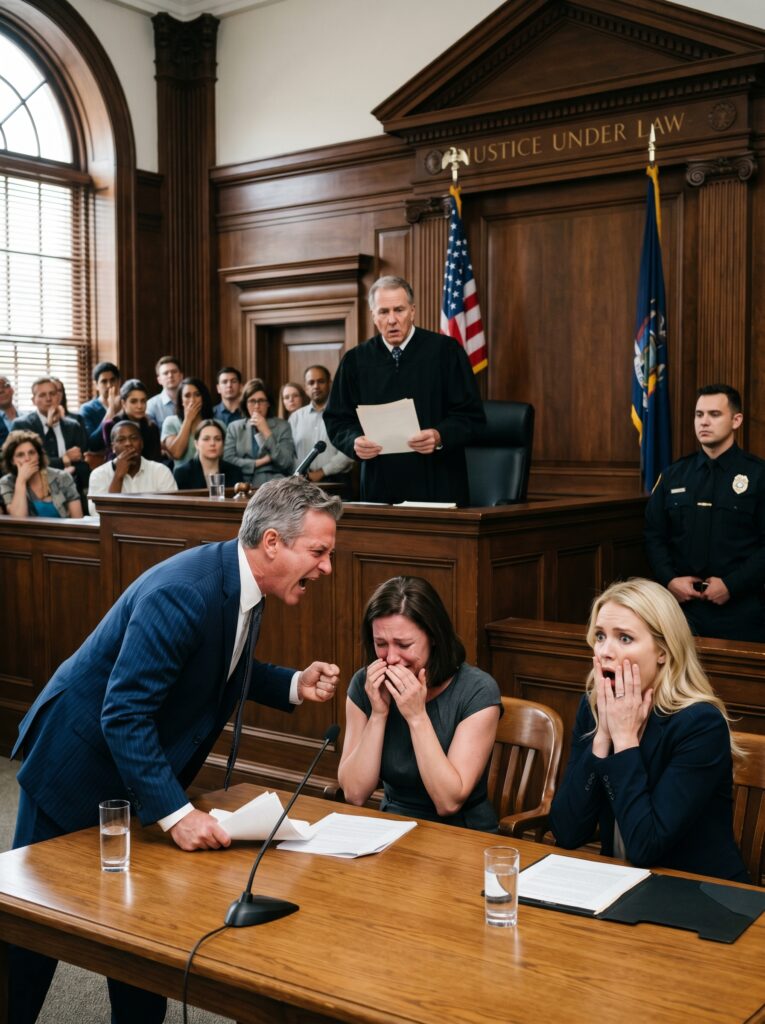
My father stood in court pointing at seven Florida Keys vacation homes saying they were all his while my mother smiled at me and said I deserved nothing, then the judge opened my grandmother’s letter and suddenly burst out laughing before whispering “Well… this is interesting” and watching my parents’ confident faces turn completely white. In the Monroe County courthouse in Key West, my father Charles Whitaker smoothed his navy tie like the judge had already ruled in his favor and my mother Evelyn gave that cold smile she always used when she thought she had already won, and behind them sat my brother Preston pretending to be on his phone while their expensive attorney Graham Phelps leaned back like a man who had already been paid from accounts I was no longer allowed to touch. I was sitting completely alone at the opposite table, no lawyer, no support, just me, Nora Whitaker, thirty-two years old, in the same charcoal dress I wore to my grandmother’s funeral two years before. The judge told me my parents were claiming I had voluntarily signed away my interest in the Whitaker Coastal Trust, and when I said I never signed anything my mother actually laughed out loud and my father shook his head like I was the embarrassing one, telling the judge I had run away after a family disagreement and only came back because the rental income had gone up. What nobody mentioned was that I had spent eight years managing those seven homes myself, replacing roofs after hurricanes, handling guest complaints, dealing with insurance inspectors, and sleeping on office floors during peak seasons while they collected the income. Then Graham stood up and presented a notarized document with my name and what was supposedly my signature from three years ago and the whole room felt like it was closing in on me until I reached into my worn leather folder and pulled out a sealed envelope, and the moment my mother saw it her smile disappeared and my father’s eyes went sharp and cold. I told the judge the letter was written by my grandmother Margaret four days before she died and had been held by her attorney in Tallahassee until last month when I finally received it, and even though Graham immediately objected the judge silenced him and opened the envelope himself. The courtroom went completely quiet as Judge Harold Benton read the first page, then the second, and then he did something nobody expected because he laughed, not a polite courtroom chuckle but a real hard laugh, and then he looked straight at my parents and said “Mr. and Mrs. Whitaker, did you know Margaret included a handwriting sample, bank records, and a video transcript with this letter?” and just like that every drop of color drained from their faces.
Part 2
The silence that followed Judge Benton’s question was the loudest thing I had ever heard in my life. My father, Charles Whitaker, a man who had walked into every room for sixty years like he already owned it, sat completely still for the first time I could remember, and my mother Evelyn’s perfectly manicured hand gripped the edge of the table so hard her knuckles turned the color of chalk. Graham Phelps, their polished attorney who had spent the entire morning leaning back like this was already over, suddenly sat very straight and very quiet, and even my brother Preston finally put his phone face down on his seat behind them. Judge Benton set the letter down slowly on his bench and removed his glasses and cleaned them, which I would later learn was something he did when he needed a moment to think carefully, and then he put them back on and looked at Graham with an expression that was no longer neutral. “Counselor,” he said, “I’m going to need you to explain something to me before we go any further.” Graham stood and straightened his jacket and said in his smoothest voice that whatever was in that letter was likely the emotional final wishes of an elderly woman and should not be treated as a legal document, and Judge Benton nodded slowly like he was considering that, and then he said “That’s a very interesting position given that what Margaret Whitaker submitted here appears to be a forensic handwriting analysis commissioned fourteen months before her death.” The air went out of the room. My father turned to Graham with a look I had never seen on his face before, not anger exactly, more like the specific panic of a man realizing the floor beneath him was not as solid as he thought. My grandmother, Margaret Eleanor Whitaker, had been eighty one years old and had walked with a cane and had called me every Sunday evening for the last decade of her life, and what nobody in that courtroom knew except me was that she had been suspicious for years. She had told me once over the phone, about eighteen months before she passed, that something felt wrong about the way Preston and my father were restructuring the trust, that papers kept appearing for her to sign that her own attorney had not prepared, and that she was taking steps to protect what she had always intended to leave to me. I had not known what steps she meant until I opened that envelope three weeks before the hearing and sat on my kitchen floor in Tampa reading for two hours straight. The letter itself was eleven pages handwritten in her careful looping script, and attached behind it were bank transfer records, a certified forensic analysis of signatures on three trust documents including the one Graham had just presented to the court, a sworn written statement from her personal physician about her mental clarity in her final months, and a USB drive containing a recorded conversation that her attorney had transcribed in full. Judge Benton held up the USB drive now and looked at Graham and said “Your client’s position is that Nora Whitaker signed this assignment of interest voluntarily in March three years ago, correct?” and Graham said yes, and the judge said “Then someone will need to explain to me why the forensic examiner your opposing party’s own grandmother hired concluded with ninety four percent certainty that the signature on that document does not match any authenticated sample of Nora Whitaker’s handwriting collected before or after that date.” My mother made a sound that was not quite a word. My father said “Harold” and then stopped himself because you do not call a sitting judge by his first name in his own courtroom and Judge Benton’s eyes moved to him with an expression that made clear he had noticed. Graham asked for a recess and the judge denied it and said he wanted to hear from my father directly, and Charles Whitaker stood up slowly like a man carrying something very heavy and said that Margaret had been confused in her last years and that the family had only been trying to protect the assets she had built, and Judge Benton let him finish and then said very quietly “Mr. Whitaker, your mother wrote in this letter that she recorded a conversation in her living room on a Sunday evening in October, and that in that conversation you told her directly that Nora had already agreed to walk away from the trust and that her signature was just a formality.” The courtroom felt like it had stopped breathing. I had heard that recording. I knew what came next. And from the look on my father’s face, so did he.
Part 3
My father stood at that podium for what felt like ten full minutes but was probably closer to thirty seconds, and in all my thirty two years of watching Charles Whitaker command every room he entered I had never once seen him look small until that exact moment in Judge Benton’s courtroom when the weight of what my grandmother had quietly and methodically documented came crashing down on everything he had so carefully built. He opened his mouth twice and closed it twice and then said in a voice that had lost every trace of its earlier confidence that he did not recall the specifics of every conversation he had with his elderly mother in her final years, and Judge Benton looked at him over the rim of his glasses and said “Mr. Whitaker, I am going to play a portion of this transcript aloud and I would like you to tell me if that refreshes your memory” and my father sat down without another word because there was nothing left to say that would not make things worse. The judge’s clerk read the relevant section of the transcript into the record and even read flat and without emotion the words landed in that courtroom like stones dropped into still water, my father’s voice captured on my grandmother’s little digital recorder that she had placed behind the ceramic lamp on her side table, telling her clearly and without ambiguity that Nora had already agreed, that Nora understood the trust needed to be simplified, that Nora’s signature was taken care of and not to worry about it. Not to worry about it. I had listened to that recording eleven times in my Tampa apartment before the hearing and every single time those five words hit me the same way because they confirmed what some part of me had known for three years but had not been able to prove, that my signature had not been obtained through coercion or misunderstanding or a document I had forgotten signing in a moment of exhaustion, it had been manufactured entirely, placed on a page without my knowledge while I was living in a rented room in Gainesville trying to rebuild my life after walking away from a family that had made it very clear I was only valuable as long as I was useful. Graham was on his feet again immediately and this time his voice had lost some of its earlier smoothness and he said that a personal recording made without counsel present and of disputed provenance should not be entered into evidence without proper authentication and Judge Benton said “Counselor, the provenance is documented in a sworn affidavit from the attorney who received this package directly from Margaret Whitaker eight days before her death, but I appreciate your concern” and the way he said it made two people in the gallery behind me quietly laugh. Then the judge did something that changed the entire temperature of the room because he turned not to my father and not to Graham but to my brother Preston, who was sitting in the gallery behind the defense table and who had spent the entire morning with his face arranged into an expression of careful boredom, and Judge Benton said “Mr. Preston Whitaker, you are not a party to this proceeding today but I notice you are present, and I want to make sure you understand that what is being entered into evidence this morning may have implications that extend beyond the scope of this civil hearing.” Preston looked up from his phone with the expression of someone who had just realized the fire he thought was safely contained in the next room had moved closer than expected. He was thirty six years old and had my father’s jaw and my mother’s eyes and had spent his entire adult life being the son my parents actually wanted, the one who stayed, the one who managed the family relationships and the family image and apparently, based on what I had found in my grandmother’s letter, the one who had physically handled the paperwork. Because that was the detail that had broken me when I first read it sitting on my kitchen floor in Tampa, it was not my father’s voice on that recording saying my signature was taken care of, it was what my grandmother had written on page seven of her letter in her careful looping script, that three days after that recorded conversation Preston had come to her house alone while my father was in Miami and had brought documents and had asked her to initial two pages and had told her it was routine trust maintenance, and that she had initialed them because she trusted him and because she was eighty years old and tired, but that afterward something had felt wrong enough that she had called her attorney in Tallahassee the very next morning. That attorney, a quiet methodical woman named Sandra Okafor who had handled my grandmother’s affairs for nineteen years, had driven to Key West herself two weeks later and had sat with my grandmother for four hours and had helped her understand exactly what those initialed pages had been attached to, and it was Sandra Okafor who had suggested the forensic handwriting examiner and Sandra Okafor who had helped my grandmother organize everything into the envelope that had been sitting in a Tallahassee filing cabinet for two years waiting for me to be ready to use it. Judge Benton was still looking at Preston when he said “I am going to recess until two o’clock this afternoon, at which time I expect all parties to return, and I would strongly suggest that anyone in this room who has not yet spoken with a criminal attorney consider making that call during the lunch hour.” The word criminal landed like a thunderclap. My mother pushed back from her chair so fast it scraped the floor loudly and turned to Graham with a expression that had nothing polished left in it and said his name in a voice I had not heard from her since I was a child, a voice with real fear underneath it, and Graham put his hand on her arm and said something quietly and my father was already on his phone before he had fully stood up and Preston, Preston who had never in his life looked uncertain about anything, was walking quickly toward the side exit with his head down when the judge’s bailiff stepped into his path and said politely but clearly that the judge had asked that all parties remain accessible during the recess. I sat at my table alone and did not move for a long moment. A woman from the gallery, a stranger, put her hand briefly on my shoulder as she passed and said nothing, just that small touch, and I had to press my lips together hard to keep myself together because I had promised myself I would not cry in that courtroom no matter what happened. Outside the tall windows the Florida sun was doing what it always does, blazing indifferently over the water, and somewhere out there were seven houses my grandmother had wanted me to have, seven houses I had poured the best years of my working life into, seven houses that had been quietly stolen from me by the people who were supposed to love me most. But my grandmother had known. She had seen it happening and she had been eighty one years old and walking with a cane and she had sat down and written eleven pages in her careful hand and she had made sure Sandra Okafor kept them safe until I was ready and the thing that finally broke through my composure, just for a moment, just for a breath, was understanding that even at the end of her life my grandmother had been fighting for me when I did not even know there was still a fight to be had. The recess clock was running and across the room Preston was on his phone now too and whatever he was saying his face had none of its morning confidence left in it at all. Two o’clock was coming and Judge Benton had used the word criminal and Sandra Okafor was already on a plane from Tallahassee and I had not even shown the court the last three pages of my grandmother’s letter yet…Sandra Okafor walked into Monroe County courthouse at one fifty eight in the afternoon carrying a structured leather briefcase that looked like it had seen the inside of a hundred courtrooms, and she was not alone. Behind her came a younger man in a gray suit who I would later learn was a certified forensic document examiner from Miami, and behind him came a woman I did not recognize until she got closer and then my breath caught because it was my grandmother’s former housekeeper, Rosa Mendez, who had worked in my grandmother’s Key West home for eleven years and who I had not seen since the funeral. Rosa caught my eye across the courtroom and gave me a small nod that carried more warmth and solidarity in it than anything my own family had offered me in years, and I had to look down at the table for a moment to collect myself before the judge returned. Graham Phelps watched Sandra walk to my side of the room and set her briefcase down next to me and something shifted in his face that he could not quite control, a tightening around the eyes that told me he knew exactly who she was and had probably been hoping she would not appear in person. My father had resumed his seat but he was not the same man who had smoothed his navy tie that morning and spoken with such easy authority about what was his and what I did not deserve, he was a sixty three year old man who had spent his lunch hour on the phone with people who were now telling him things he did not want to hear, and it showed in the set of his shoulders and the careful way he avoided looking at me directly. My mother had reapplied her lipstick and rebuilt her composure into something that resembled its morning version but only if you did not look at her hands, which she was pressing flat against the table in front of her to keep them still. Preston had come back into the courtroom at one fifty six and had sat not behind my parents as he had all morning but in the far corner of the gallery with a man in a dark suit who had appeared from somewhere during the recess and who had the specific alert stillness of a criminal defense attorney who has been briefed very quickly and is still processing the full dimensions of what his new client has done. Judge Harold Benton returned at exactly two o’clock and the bailiff called the room to order and the judge looked out at the changed landscape of the courtroom with the expression of a man who had presided over enough hearings to recognize when a morning’s worth of phone calls had rearranged everything, and he said “I see we have some new faces. Ms. Okafor, I presume?” and Sandra stood and said “Yes Your Honor, Sandra Okafor, I was Margaret Whitaker’s attorney of record for nineteen years and I am here to authenticate the documents submitted this morning and to provide additional materials that were held under separate instruction.” Judge Benton nodded and said “I expected you might be, please be seated, we will get to you shortly” and then he looked at Graham and said “Counselor, before we proceed I understand you have something to address” and Graham stood and his voice was measured but the ease was entirely gone from it now and he said that in light of the morning’s developments he needed to request a continuance of no less than thirty days to review the newly submitted materials and consult with his clients, and Judge Benton looked at him for a long moment and said “Mr. Phelps, the materials submitted this morning were drawn from a package your opposing party’s grandmother prepared nearly two years ago and which has been in the custody of a licensed Florida attorney ever since. The novelty is yours, not the court’s. Request denied.” Graham sat down and did not try again. Then something happened that nobody in that courtroom had anticipated because the man in the dark suit sitting next to Preston in the corner gallery stood up and said “Your Honor, I apologize for the interruption, my name is David Carreno and I have just been retained by Preston Whitaker, and I need to inform the court that my client wishes to make a statement.” Every head in the room turned. My father turned around in his chair so fast I thought he might injure himself and the look that passed between him and Preston was the most honest thing I had ever seen on either of their faces, raw and unguarded and full of a fracturing that had probably been building for years beneath the surface of their carefully maintained alliance. Judge Benton said “Mr. Carreno, this is a civil proceeding and your client is not currently a named party, however I will hear a brief statement given the morning’s record.” Preston stood up and he looked, for the first time in his thirty six years on this earth, genuinely afraid, not of me, not of the judge, but of my father, and I understood in that moment that whatever had happened three years ago with the documents and the signatures had not been a partnership of equals but a hierarchy, and Preston had been the one who did the physical work while my father provided the direction, and now that the walls were coming in Preston had spent his lunch hour doing the math and the math had told him something important about where he stood. He said in a voice that was quieter than I had ever heard from him that he wanted the court to know he was prepared to cooperate fully with any investigation and that he had acted under the belief that the family’s handling of the trust was legally sound, and before he could finish Graham was on his feet objecting loudly and my father said Preston’s name in a voice like a door slamming and Judge Benton banged his gavel once and said “Mr. Whitaker, you do not have the floor and you will not speak again without being recognized, am I understood?” and my father sat back with an expression I would carry with me for the rest of my life. Sandra Okafor opened her briefcase then and with the judge’s permission approached the bench and handed up a series of documents that she narrated quietly and precisely as she presented them, the original trust instrument drafted by my grandmother in 2009 which named me as a forty percent beneficiary alongside my father’s thirty five and Preston’s twenty five, the certified forensic report concluding that my signature on the assignment document was not authentic, a second forensic report that Sandra had commissioned independently six months after the first and which reached the same conclusion with ninety one percent certainty, and then she handed up a single page that made Graham close his eyes briefly when she announced what it was, a notarized statement signed by Rosa Mendez describing in specific detail what she had witnessed on the afternoon Preston visited my grandmother’s home with documents, including the fact that my grandmother had asked Rosa to stay in the adjoining room while Preston was there and had squeezed Rosa’s hand afterward and said in Spanish that she needed to make a phone call and Rosa should please remember today’s date. Rosa had written the date in her personal diary that same evening. She had kept that diary. She had brought it with her to the courtroom and it sat in Sandra’s briefcase with the entry tabbed and ready. Then Sandra said “Your Honor, with the court’s permission I would like to address the final three pages of Margaret Whitaker’s letter which have not yet been entered into the record” and Judge Benton said “Please proceed” and Sandra turned to face the courtroom rather than the bench and I realized she had done this before, had stood in rooms and delivered information that changed the shape of things, and she did it now without drama or performance, just clearly and steadily, and what she read from those final three pages was my grandmother’s voice coming back into that courthouse one last time. My grandmother had written that she was not a foolish woman and had not been one even at eighty one years old even with a cane and a heart that was tiring and she had known when she felt the shape of what was happening to her trust and to me and she had been angry in the way that only very old women who have spent decades being underestimated are permitted to be angry, quietly and with tremendous patience and great precision. She had written that she loved her son Charles but that love did not require her to pretend she could not see what he was, and that she had watched him for sixty years turn everything around him into something he controlled and she had hoped he would not do it to Nora but she had prepared for the possibility that he would. She had written that Preston had her own eyes and her own stubbornness and that she had grieved the use he had put those qualities to. And then she had written about me. She had written that Nora had her grandfather’s hands and her great aunt Clara’s determination and that of all the people who had moved through her long life the one she trusted most to take care of the homes she had built from nothing on those islands was the granddaughter who had actually shown up for eight years and done the work without being asked and without complaint and without recognition, and that it was her most specific and considered wish that those seven properties be returned to Nora in full, not as a gift, not as compensation, but as the fulfillment of what had always been intended and what had been taken through deception. Sandra stopped reading and the courtroom was completely silent. I was not successful at keeping my composure through all of it and I did not try anymore and there was no shame in it. Judge Benton was quiet for a moment and then he said “Ms. Whitaker, I want to ask you directly, what outcome are you seeking today?” and I stood up and my voice was steadier than I expected it to be and I said “Your Honor, I want what my grandmother intended me to have. I want the trust restored. And I want the record to reflect what was done.” The judge nodded slowly. He looked at my parents and at Graham and at the corner of the room where Preston sat with his new attorney and then he looked back at me and said “Ms. Whitaker, on the basis of the evidence submitted today I am finding sufficient cause to void the assignment of interest dated three years ago pending full forensic review, I am referring the matter of the disputed signature to the Florida State Attorney’s office for investigation, and I am issuing a temporary injunction freezing all transactions related to the Whitaker Coastal Trust pending resolution.” He paused and then said “I am also noting for the record that Margaret Whitaker appears to have been an exceptionally thorough woman” and somewhere in the gallery behind me someone started clapping before they caught themselves. My father did not look at me when they stood to leave. My mother walked past my table close enough that I could smell her perfume, the same perfume she had worn my entire childhood, and she did not look at me either. Preston paused for just a moment near the door and I thought he might say something and then David Carreno touched his arm and they kept walking. Sandra sat down beside me and put the documents back into her briefcase with the same quiet precision she had shown all afternoon and then she looked at me and said “Your grandmother asked me to tell you something if this day ever came” and I said “What did she say” and Sandra smiled for the first time and said “She said you were always the one who turned the lights on in those houses. She said they were always yours.” I walked out of the Monroe County courthouse into the full force of a Florida afternoon, the sun on the water so bright it was almost painful, and I stood on the steps for a long moment just breathing the salt air and thinking about seven houses on those islands where I had spent the best and hardest years of my working life, thinking about my grandmother at her side table with her little recorder and her careful handwriting and her nineteen year relationship with a methodical attorney from Tallahassee who had flown down that morning with a forensic examiner and a briefcase full of everything she had needed me to have. The legal process would take months and the investigation would take longer and there would be difficult days ahead that I could not yet fully see the shape of. But Margaret Whitaker had been an exceptionally thorough woman and she had made sure that when the moment came, I would not be standing in that courtroom alone. I pulled out my phone and I called the only person I wanted to talk to right then, my grandmother’s old number which I had never deleted, and of course it rang and rang and no one answered, but I stood there in the Florida sun and I talked to her anyway and I said thank you and I meant it with every part of myself, and the water in the distance caught the light and held it the way it always had down in the Keys, indifferent and endless and quietly, perfectly beautiful.
SHORT SUMMARY:
Nora Whitaker stood alone in a Florida courtroom at thirty two years old, no attorney, no money, no powerful allies, facing her wealthy father, her cold mother, her calculating brother Preston, and their polished lawyer, all of them united behind a single forged signature that had stolen her rightful share of seven Florida Keys vacation homes she had spent eight years of her life maintaining and protecting. Her family had rewritten history, erased her contribution, and expected her silence. What they never accounted for was her grandmother Margaret, who had seen everything coming, commissioned forensic handwriting experts, recorded private conversations, organized bank records, written eleven pages in her careful hand, and quietly placed everything into the custody of her trusted attorney Sandra Okafor with instructions to wait until Nora was ready. When that sealed envelope was opened in court and Judge Benton read what Margaret had prepared, the carefully constructed lies her family had polished for years collapsed in a single afternoon, and the word that changed everything was not spoken by Nora or by any attorney but by the judge himself when he looked at her parents and said the word criminal.
THE LESSON:
The most powerful thing this story teaches us is that doing the right thing in silence is never wasted even when no one is watching and no one is recording the score. Nora spent eight years replacing roofs and sleeping on office floors and managing those homes without complaint and without recognition and her family mistook her quiet dedication for weakness and her absence for surrender. But her grandmother watched. And what her grandmother understood that her father never did was that loyalty and integrity leave a record even when no one is keeping one officially, and that the truth does not expire just because powerful people decide to bury it. Margaret Whitaker did not fight loudly or dramatically, she fought the way wise women have always fought, patiently, thoroughly, and with tremendous love for the person she was protecting. The second lesson is equally important and it is this: never confuse someone’s gentleness for the absence of preparation. The people in that courtroom who smiled the widest and leaned back the most confidently were the ones who had done the least actual work, and the woman who walked in alone in a funeral dress with a worn leather folder was the one who had everything she needed. Nora did not win because she was loud or aggressive or well connected. She won because her grandmother loved her enough to spend her final months making sure that when the moment came, the truth would be impossible to ignore. And if you are somewhere right now feeling unseen and underestimated and quietly carrying a weight that nobody around you seems to acknowledge, this story is for you, because sometimes the justice you deserve is already being prepared in ways you cannot yet see, by people who love you more carefully and more completely than you even know.