My name is Harper Williams. I was twenty-two years old and about to graduate from Harvard Business School when my father told me to take the bus to my own ceremony because he and my mother were busy buying my sister a Bentley.
He said it without hesitation.
“We can’t drive you, Harper. Take the bus. We’re picking up Cassandra’s car.”
Cassandra was eighteen and graduating high school.
I was graduating from Harvard summa cum laude after four years of scholarships, exhaustion, three part-time jobs, and the quiet, grinding belief that maybe—just maybe—if I achieved enough, they would finally see me.
They had money. That was never the issue.
My father, Robert Williams, was the chief financial officer of a Fortune 500 company. My mother, Elizabeth, was a respected neurologist in Boston. We grew up in a sprawling Connecticut home where excellence was expected, not celebrated. Achievement wasn’t a reason for joy. It was simply the minimum price of being tolerated.
At least for me.
Cassandra was different.
She had been different from the moment my parents brought her home—blue-eyed, golden-haired, delicate in the way adults rush to protect. I was four years old when the spotlight shifted, and from then on, I became the reliable older child, the example, the one who was supposed to understand.
For my eighth birthday, I received educational books.
Two months later, Cassandra had a princess party in the backyard with a pony.
When I asked to attend science camp instead of the family beach trip at twelve, my mother patted my head and said, “Maybe next year, Harper.”
Next year never came.
My straight-A report cards earned a nod and, “That’s what we expect from you.” Cassandra brought home B’s and C’s and received glowing praise for “trying her best.” I joined debate, edited the school newspaper, took every advanced placement course I could fit into my schedule, and studied until midnight most nights, desperate for the kind of pride my parents gave Cassandra for a minor role in the school play.
I never hated my sister.
Not really.
She had been shaped by the same house, just from the other side of the table. She grew used to getting what she wanted because no one taught her what it cost. When she crashed her brand-new Audi at sixteen, my father replaced it the next day. When I asked for help buying a used Honda for college, he told me to save from my part-time job.
The memory that hardened something in me came senior year of high school.
I had been named valedictorian.
The ceremony fell on a Tuesday evening in May. When I reminded my parents, my mother winced.
“Oh, Harper, that’s the same night as Cassandra’s piano recital. She’s been practicing for months. You understand, right?”
I nodded automatically.
That night, I stood at the podium and gave a speech about perseverance while scanning the audience for faces that weren’t there.
Afterward, I made a decision.
I had received a partial scholarship to Harvard. My parents had vaguely mentioned helping with expenses, but I decided I would never ask them for a dime.
That summer, I worked three jobs: barista in the morning, office assistant in the afternoon, tutor in the evenings. I saved everything. When August came, I packed my life into two suitcases and declined my parents’ offer to drive me to Cambridge.
“I’ve got it covered,” I said.
My mother looked briefly concerned. “Do you have enough money for the semester?”
“I’ve been saving.”
My father barely looked up from his newspaper. “College is expensive. Don’t waste money on frivolous things.”
That was my sendoff.
Meanwhile, Cassandra started freshman year of high school with a complete wardrobe overhaul and a new MacBook Pro.
At Harvard, reality hit hard. My scholarship covered tuition, but everything else—housing, books, meals—came out of my pocket. I lived in the smallest dorm room I could find, ate ramen more often than I admitted, worked at the university library in the mornings, delivered food between classes, and spent weekends folding clothes at a retail store in Cambridge.
Sleep became something other people had.
During those years, I met Jessica Rodriguez, another business student fighting her way through school without a safety net. She came from a single-parent home in Arizona and worked nearly as hard as I did. We split textbooks, cooked cheap meals in the communal kitchen, and became each other’s emergency contact in every way that mattered.
One night, while we were highlighting used textbooks, Jessica asked, “How can your parents not help you at all when they clearly can?”
I shrugged. “They believe in self-sufficiency, I guess.”
“That’s not self-sufficiency,” she said sharply. “That’s neglect.”
It was the first time someone had named it without softening the edges.
In sophomore year, I dated Jake Thornton, charming and wealthy and kind in the way people are kind when they’ve never had to choose between groceries and textbooks. He tried to pay for dinners, trips, everything. I insisted on paying my half, even if it meant picking up extra shifts afterward.
He never understood.
“Just let me help,” he would say. “Or ask your parents. Why make everything so hard?”
We broke up after he surprised me with tickets to Paris for spring break and I told him I couldn’t go because I had already committed to work. He called me stubborn and ungrateful.
Maybe I was.
Or maybe I had learned early that accepting rescue often came with a bill no one named upfront.
The turning point came junior year in Professor Wilson’s financial technology course.
After I submitted a paper on emerging digital payment systems, she asked me to stay after class.
“This is graduate-level work, Harper,” she said. “Have you considered fintech as a serious career path?”
That conversation changed everything.
Professor Wilson became the first adult in years who looked at me and saw potential instead of obligation. She recommended books, introduced me to industry contacts, challenged my ideas, and believed in my mind without making me earn basic respect first.
Under her guidance, I began studying cryptocurrency and blockchain technology. This was 2019, when Bitcoin was recovering from a crash and digital currencies still felt like a frontier most people misunderstood. I spent endless nights in the library researching security flaws in early crypto platforms, learning to code, and sketching out a system that could make transactions safer and more accessible.
By the end of junior year, the idea had a name.
Secure Pay.
A platform designed to make cryptocurrency transactions as easy and secure as traditional banking.
Professor Wilson pushed me to enter Harvard Business School’s annual startup competition. I spent weeks refining the pitch, building a prototype, and preparing for every question the judges might throw at me.
The night before the competition, I rehearsed for Jessica until she finally closed my laptop.
“Harper, sleep. You know this inside and out.”
Over one hundred student ventures competed.
Secure Pay won.
The prize was $50,000 in seed funding and office space in the university innovation center. It was more support than my own family had ever given me.
The win attracted angel investors, including Michael Chen, a tech entrepreneur who had made his fortune in social media. Over lunch, he offered me $2 million for the entire concept.
Two million dollars.
Enough to pay off every loan, secure my future, and stop worrying about money for the first time in my life.
But when he finished speaking, I heard myself say, “Thank you, but I’m not looking to sell. I believe in what I’m building.”
He looked surprised.
“Most students would take that offer.”
“I’m not most students.”
The next day, he came back with a different proposal: $500,000 for fifteen percent of Secure Pay.
I accepted.
With his investment, I incorporated the company, hired two computer science students as part-time developers, and brought on a graduate student with marketing experience. We worked out of a cramped room in the innovation center, often coding until morning.
It was brutal.
Three months in, we found a critical flaw in our security protocol and had to rewrite almost half the code. One developer quit right before a deadline. Money dwindled. We were still months away from launch.
One night, I called Professor Wilson in tears.
“I think I made a huge mistake. We’re going to run out of money before we even have a product.”
“Every founder reaches this point,” she said. “The question is whether you push through or give up. Which one are you?”
I pushed through.
Jessica helped with admin work for free after classes. I took on more coding myself. We survived by stubbornness, exhaustion, and the refusal to let the thing die.
Then, in March of senior year, we cracked it.
Our proprietary security algorithm processed crypto transactions thirty percent faster than existing platforms while maintaining bank-level protection. When we demonstrated it to Michael, he went still.
“This changes everything,” he said. “How fast can you prepare for Series A?”
With his connections, we pitched venture capital firms in Boston and New York. Our timing was perfect. Crypto was surging back into conversation, and investors were hungry.
A month later, we closed a $50 million funding round at a $700 million valuation.
I kept it quiet.
No interviews. No announcements to my family. Only a handful of people knew what Secure Pay had become.
Part of me wanted to prove I could succeed without them.
Another part wanted to see their faces when they finally learned what I had built while they were busy treating me like the daughter who could always manage alone.
By graduation, Secure Pay had thirty employees, a beta platform with glowing feedback, and a valuation just over $1 billion. In startup terms, we were a unicorn.
And I was a paper billionaire at twenty-two.
Yet when graduation approached, the childish part of me still wanted my family there. I mailed formal invitations to my parents and Cassandra, including ceremony tickets and a handwritten note saying how much it would mean to have them attend.
My father called a week later.
“We received your invitation,” he said.
“I hope you can come.”
A pause.
“We have a conflict that weekend.”
My stomach sank. “What kind?”
“Cassandra’s high school graduation is the same week, and we have several activities planned. The timing won’t work for us to drive to Cambridge.”
“Her graduation is Thursday. Mine is Saturday. You could attend both.”
“We’re also taking her to New York for a shopping trip as part of her graduation gift. Plans have been set for months.”
“This is my Harvard graduation, Dad. It’s a big deal.”
“Of course,” he said. “We’re very proud. But you’ve always been self-sufficient. I’m sure you’ll handle this on your own too.”
Then came the line I would never forget.
“You’ll have to take the bus to your ceremony. We’re buying your sister a Bentley for graduation.”
I nearly dropped the phone.
“A Bentley? She’s eighteen.”
“She worked hard,” he said. “She got into UCLA. We want to reward her.”
Cassandra had gotten into UCLA with a 3.2 GPA and our father’s legacy connection.
I had gotten to Harvard on merit, kept a 4.0, worked three jobs, built a billion-dollar company, and still apparently needed a bus schedule.
“I see,” I said.
Then my mother’s voice came through speakerphone.
“You’ve always been the responsible one, Harper. We never have to worry about you.”
They meant it as praise.
It landed like the sentence of a life where competence had been punished and dependency had been rewarded.
After the call, I stood frozen on the sidewalk outside Secure Pay until Jessica found me.
“They’re buying Cassandra a Bentley,” I said hollowly. “And they can’t drive two hours to see me graduate from Harvard.”
Jessica put her arm around me.
“They don’t deserve to be there. We’ll be there. Professor Wilson, me, your team. We are your family now.”
Professor Wilson called later and was more blunt.
“Some people cannot celebrate success because it reminds them of their own limitations. Don’t let their absence shrink your achievement.”
I decided I would take the bus to graduation exactly as my father had suggested.
There was poetic justice in it.
I would arrive by public transportation to receive a Harvard diploma, then return to my office as CEO of a billion-dollar company.
Two days before graduation, Dean Harrison requested an urgent meeting.
I went in worried something was wrong with my degree.
Instead, he smiled.
“Forbes called,” he said. “You’ve been named to their 30 Under 30 list. More significantly, they’re featuring you as the youngest self-made female billionaire in technology.”
I blinked.
“I know you value privacy,” he continued, “but this is an extraordinary achievement for you and for Harvard. With your permission, we’d like to recognize it during the ceremony.”
My first instinct was to say no.
I had gotten used to succeeding quietly.
Then I thought of my parents—if they came at all—expecting me to walk across the stage, collect my diploma, and return quietly to the background.
“What exactly would you say?” I asked.
“A brief mention during your introduction as valedictorian.”
I nodded.
“That would be fine.”
As I left his office, my phone buzzed.
Cassandra: Mom and Dad decided we can come to your graduation after all. See you Saturday.
I stared at the message.
They had changed their minds.
But something told me it wasn’t because they had suddenly understood what the day meant.
Graduation morning was clear and beautiful. I adjusted my cap, smoothed my robe, and kept my original plan.
I took the bus.
It was nearly empty. I sat by the window, watching Cambridge pass by, thinking about the girl who had arrived there with two suitcases, no safety net, and more fear than she was willing to admit.
My phone filled with congratulations from the Secure Pay team and a message from Jessica saying she had saved seats near the front with Professor Wilson.
When I arrived at Harvard Yard, the lawn had transformed into a sea of white chairs and crimson banners. Families took pictures. Graduates hugged. People cried.
I spotted my family near registration.
My father in a dark suit.
My mother in pale blue.
Cassandra scrolling on her phone.
They had not seen me yet, and for one moment, I looked at them from a distance, realizing I was no longer the same person who had spent years waiting to be chosen.
“You made it,” I said.
My mother gave a practiced smile. “Harper, look at you.”
My father offered a handshake instead of a hug.
“Traffic was better than expected.”
Cassandra glanced up. “Congrats, sis. Can you believe they dragged me out of bed at five for this?”
“I appreciate you coming,” I said.
Some small part of me still meant it.
Graduates were called to line up, and I told them their seats were in the third row. As I walked away, I heard Cassandra ask, “Do we really have to stay for the whole thing?”
The ceremony began with all the tradition Harvard could summon. When my turn came, I rose and walked toward the stage.
“Harper Williams,” Dean Harrison announced, “graduating summa cum laude with highest distinction in business administration.”
I accepted my diploma.
Then he did not move to the next name.
Instead, he kept the microphone.
“Ladies and gentlemen, I have the extraordinary privilege of announcing that Miss Williams is not only our class valedictorian, but has also been recognized by Forbes as the youngest self-made billionaire in this year’s graduating class, having founded Secure Pay, a financial technology company revolutionizing cryptocurrency transactions.”
A gasp moved through the crowd.
Then applause erupted.
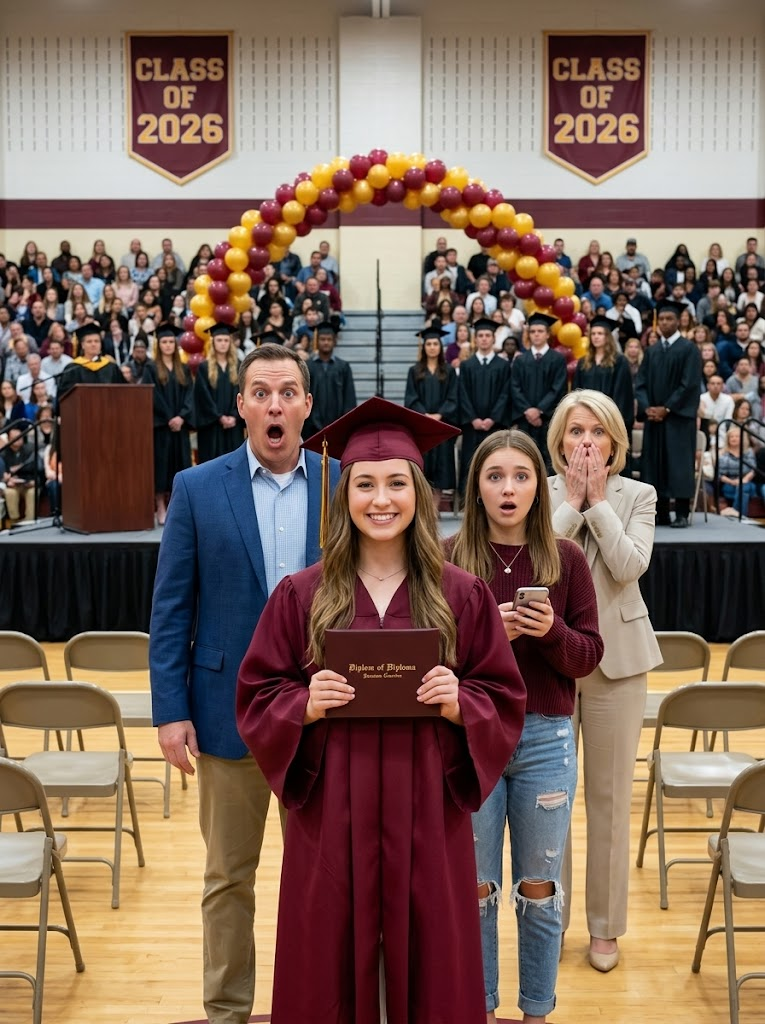
I looked toward my family.
My father had dropped his program, pages scattered around his shoes. My mother sat frozen, one hand over her mouth. Cassandra stared at me with her jaw open, her phone finally forgotten.
For once, they were watching.
The dean gestured for me to take the podium.
I adjusted the microphone and unfolded my speech.
“Four years ago,” I began, “many of us arrived at Harvard with ambition, fear, and dreams we weren’t sure we had the strength to carry.”
I spoke about resilience, innovation, purpose, and the quiet power of believing in yourself before the world gives you a reason. I did not mention my parents. I did not turn the stage into revenge.
This moment was not about humiliating them.
It was about celebrating the person I had become without them.
Near the end, I said, “Success is not measured only by recognition or wealth, but by the obstacles we overcome and the person we become in the process. Mine involved building a company between classes and discovering I was capable of far more than I had been led to believe.”
The applause was thunderous.
When the ceremony ended, classmates, professors, alumni, and investors surrounded me. People who had known me only as the quiet student who worked too much suddenly understood what I had been carrying.
Through the crowd, I saw my family coming toward me.
My father looked urgent. My mother’s face held confusion and calculation. Cassandra trailed behind them, looking at me with something that seemed almost like admiration.
“Harper,” my father said loudly, extending his arms. “Why didn’t you tell us? A billion-dollar valuation? Extraordinary.”
I accepted his hug stiffly.
“It never seemed relevant to our conversations,” I said. “You were always focused on Cassandra’s accomplishments.”
My mother stepped forward with her social smile.
“Darling, we’re so proud. You must tell us everything about this company.”
The sudden interest was jarring. I could almost see my value recalculating behind their eyes.
“Secure Pay has been my focus for two years,” I said professionally. “We built a secure crypto transaction platform addressing mainstream adoption concerns.”
“Two years?” my father said. “Why didn’t you ask for my help? I have considerable financial experience.”
I almost laughed.
“I didn’t think you’d be interested. You made it clear early that I should handle my education independently.”
Jessica joined us then, extending her hand.
“Mr. and Mrs. Williams, I’m Jessica Rodriguez. Harper’s friend and COO of Secure Pay. Your daughter is the most brilliant person I’ve ever met. You must be thrilled to have raised such an innovator.”
My father shook her hand automatically.
“The Williams family has a tradition of excellence,” he said.
Cassandra, unusually quiet, finally spoke.
“Is it true? You’re actually a billionaire now?”
There was no jealousy in her voice.
Only awe.
“On paper, yes,” I answered. “The company is valued above a billion, and I retain majority ownership.”
“That is so cool,” she said. “I always knew you were smart, but this is next level.”
Her admiration felt more genuine than my parents’ praise.
For the first time that day, I smiled at her.
My father cleared his throat.
“We should celebrate. I made reservations at La Meren. The four of us can catch up, and you can tell us about your business plans.”
Just like that, my graduation had become a business discussion.
“Actually, I already have plans,” I said. “My team arranged a graduation party.”
My mother’s smile tightened.
“Surely you can reschedule with your employees. Family comes first.”
The irony was almost beautiful.
“These people aren’t just employees. They supported me every step of the way. They were there when I needed guidance, help, or someone to believe in me. So no. I won’t reschedule.”
My father’s expression hardened.
“We came all this way to celebrate you.”
“You came because Cassandra told you about the article,” I said.
Cassandra looked up. “Actually, that’s true. I saw a Business Insider piece about Secure Pay last week. I showed them. Dad didn’t believe it was you until he checked the company website.”
There it was.
Not a change of heart.
A change of valuation.
The realization hurt, but it also freed something inside me.
“Thank you for telling them,” I said to Cassandra.
My father tried again.
“We have a lot to discuss about your future. As your father, I can offer insight into managing wealth and growth. Perhaps we can join your celebration briefly, then have family dinner afterward.”
I looked at him clearly.
“Dad, I’ve managed without your insight for four years. My company has excellent advisers, a strong board, and a dedicated team. What I wanted today was for my family to be proud of me for graduating from Harvard. Not for the company. Not for the money. Just for finishing this chapter.”
My mother said smoothly, “Of course we’re proud of your graduation. The business is just an added bonus.”
“Is it?” I asked. “Because when it was only my Harvard graduation, you were planning to skip it for a shopping trip.”
Silence fell.
Nearby families stopped pretending not to listen.
Then Cassandra surprised all of us.
“Can I come to your party instead?” she asked. “I want to hear more about your company. And honestly, I’m tired of being the center of attention all the time.”
I looked at her differently then.
Maybe she had been trapped too.
Not in neglect, but on a pedestal she had never chosen.
“You’re welcome to come,” I said.
My father frowned. “Cassandra, we had family plans.”
For perhaps the first time, my sister stood her ground.
“I want to spend time with Harper. You two can go to dinner.”
My mother recalculated again.
“Perhaps we could all attend Harper’s celebration.”
I shook my head.
“I think we need space. Cassandra can come if she wants, but I’m not ready to pretend everything is fine just because you discovered I’m successful.”
My father flushed.
“After everything we’ve done for you—”
“What exactly have you done for me, Dad?” I asked quietly. “I worked three jobs to put myself through school. I built my company without your money or advice. I took the bus to graduation today, just like you suggested.”
He had no answer.
I spotted my team waiting near the lawn.
“I should go. Cassandra, we’ll be at the Charles Hotel rooftop if you want to join us.”
As I turned, my mother called after me.
“Harper, we are still your parents. We deserve to be part of your success.”
I looked back.
“You can be part of my life going forward if you want. But it will have to be on different terms. I’m not that desperate little girl begging for approval anymore. I know my own worth now.”
Then I walked away to join the people who had actually shown up for me.
For once, my parents watched me leave.
One year later, I stood at the floor-to-ceiling windows of my Manhattan penthouse as sunset painted the skyline gold and pink.
The view still took my breath away.
On the wall behind me was the framed Forbes cover with my photo and the headline: The Billion-Dollar Underdog: How Harper Williams Revolutionized Cryptocurrency While Still in College.
Secure Pay had grown beyond anything I had imagined. More than five million users. Technology licensed by three major international banks. Offices in New York, San Francisco, and London. Over two hundred employees. A valuation above $5 billion.
But the true transformation was not financial.
It was internal.
The approval-seeking girl who took the bus to graduation had become a woman who knew her value did not depend on who clapped.
Healing was not easy. There were still nights when old memories surfaced sharp and familiar. A therapist in New York, Dr. Lawson, helped me understand that my parents’ inability to see me had never been proof of my worth.
“Some parents,” she told me, “cannot see their children as separate people with needs outside their own narrative. That is their limitation, not yours.”
The most unexpected healing came through Cassandra.
After graduation, she joined my celebration and saw the respect my team had for me. Two weeks later, she asked to meet for coffee in Los Angeles.
That coffee became four hours of honesty.
She confessed she had always admired me but felt intimidated by what looked like effortless perfection.
“I never wanted the Bentley,” she admitted. “I just wanted them to look at me the way they looked at you when you brought home perfect report cards.”
For the first time, I saw her clearly.
The pedestal had isolated her too.
When Cassandra admitted she only applied to UCLA because our father insisted, I encouraged her to take a gap year. Two months later, to our parents’ horror, she deferred enrollment, volunteered with a marine conservation program in Hawaii, and refused the Bentley.
“I want to try doing things the Harper way,” she told them. “On my own terms.”
Now she lived in the guest suite of my penthouse and worked for the charitable foundation I had created to support underprivileged students with scholarships, technology, books, and living expenses—the things I had needed and never received.
Our relationship became real, not competitive. We were learning to be sisters in a way our parents had never allowed.
My parents tried to insert themselves into my success. My father suggested joining Secure Pay’s board to provide “seasoned guidance.” My mother tried arranging photoshoots for family-friendly business magazines, positioning herself and my father as the force behind my achievements.
I set boundaries.
Limited contact.
Short calls.
Structured holiday visits.
No rewriting the past.
Dr. Lawson helped me understand that forgiveness was not pretending the hurt never happened.
“You don’t owe them the success story they’re trying to claim,” she said. “Your narrative belongs to you.”
The Secure Pay Foundation became one of my proudest accomplishments. We used ten percent of company profits to fund students who were determined to succeed despite limited family support. Jessica, now both COO and my closest friend, oversaw the foundation. Professor Wilson joined our advisory board after retiring from Harvard.
These women, along with my team and Cassandra, became the family I built for myself.
A family based on care, respect, and showing up.
Every time my parents overlooked me, every time they chose Cassandra, every time they told me to handle things alone, they accidentally taught me how to stand.
The journey had been painful, but every disappointment had redirected me. Every moment I believed in myself when no one else did became part of the structure holding me now.
As sunset faded behind the skyline, Cassandra entered the living room smiling.
“The foundation committee approved all five scholarship recipients,” she said. “Including that girl from Arizona who reminds me of you—the one working three jobs to save for college.”
I smiled.
“Make sure she knows she doesn’t have to take the bus to her graduation. We’ll send a car.”
Cassandra laughed.
“Or better yet, a Bentley.”
Our laughter filled the room—not bitter, not performative, but healed enough to be light.
I had found my path.
Built my success.
Created a family that celebrated my light instead of diminishing it.
And that, more than any valuation or headline, was the true measure of how far I had come.